Showing posts with label His in Herland. Show all posts

The Problem of Isolation

It is typical of utopia novels/tracts to start with "I met a man who told me about..." similar to Coleridge's "Rime of the Ancient Mariner."

More's Utopia, for instance, is described by a traveler, Raphael, who claims the island was already populated when a group of Romans and Egyptians arrived there in a shipwreck. The resulting perfection is a combination of those cultures. James Hilton's Shangri-la is described by one man to another man based on the first man's encounter with Conway (the Ronald Colman character in the 1937 movie). Shangri-la is in the mountains and only reached by Conway and his companions when their plane is hijacked. 

All versions of His in Herland have struggled with this problem. In one version, I created trade between Herland, an island, and the mainland over a bridge. 

In the current version, I place Herland in a far more isolated position, even more isolated than in Gilman's book. In the book, the young men hear stories about the country (about the size of Holland) from guides plus they discover woven cloth in a river. Stuff leaks out.

The problem, of course, is that in reality, people also tend to leak out. Why wouldn't Utopia's fisherman keep going? Why wouldn't Herland's citizens up and leave? George Mallory isn't the only one who wanted to climb a mountain because it was there.

In fairness, Gilman's women are infinitely practical, which is a welcome change from rampaging idealism, but human nature is not infinitely practical, male or female. Road trips and rituals like Rumspringa exist for a reason. Good grief, Gilman got a divorce and hauled herself and a child all the way across the country to California--why wouldn't her women do the same? For that matter, at age 25, I drove cross-country in a non-air-conditioned Dodge Colt (stick shift) in the summer with a cat by myself. I would never do that now! (People get more risk-adverse as they age.) 

Even during Japan's most extreme isolationist period, people still knew it was there and eventually showed up in a "here we are; what are you going to do now?" way. (And, yes, people did leave, even if they did so partly unintentionally. Courtesy of Eugene, see John Manjiro, "whose biography would barely be believable as fiction.")

In addition, one of the most fascinating revelations of archeological digs is how much people in the past got around. Goods from Asia show up in medieval England. Folks from England show up in the Mediterranean world.

Not to forget, during the nineteenth century, that time of no-holds-barred nationalism, the attempt by antiquarians to discover the "pure" past of a nation ended in failure. German fairy tales weren't German--for one, a lot of them were French. 

And so on.

Isolation is necessary to utopias. Mobile people undermine utopias since (1) restless people indicate that people care about more than "needs" (sorry, Marx); (2) if mobile people can leave, other mobile people can arrive, and there goes the perfectly structured society. 

Star Trek tackled this problem in several ways (setting aside the utopian ideals of the show itself). TOS tackled it philosophically: How can you thrive if you are too happy? TNG tackled it, to my mind, somewhat more realistically. In "Masterpiece Society," the engineers on the planet are too excited about Enterprise technology to give it up. Now we see the cost of not being part of a space-faring community! No, thanks!

Welcome to human nature. 

To avoid the plot issues created by constantly mobile people (hard to write a critique of a utopia if the upshot is, "Yeah, well, it lasted about ten minutes"), the current version of His in Herland is extremely isolated--though Terry suggests that even this state of affairs can't last. 

People are always going to come.

Chapter 2

The Problem of Sameness, Part I: Hair

Charlotte Perkins Gilman was a skilled writer. 

Her six protagonists in Herland, if one includes Terry, have distinct and memorable personalities. She achieves this feat easily early on and never wavers:

Van is reflective, diffident, romantic, and observant. He is basically Henry from Northanger Abbey

Jeff is chivalrous and mild-mannered. He is more intensely romantic than Van since what he perceives as romance is a narrative in his head and based on almost entirely erroneous assumptions. But he never challenges his assumptions, so hey, he is happy!

Terry is brash, chauvinistic, and domineering. 

Ellador is curious, intellectual, and direct. She and Van become the perfect yuppie couple who will tour the world and write books about it. They will have, in all fairness, a decent marriage. 

Celis in the book is sweet and fragile. I, however, give her a core of ruthlessness. Celis gets what Celis wants. She wants Jeff because she can do whatever she wishes with him. That is, my Celis is more Bianca than Katerina from Taming of the Shrew. Butter-won't-melt-in-her-mouth yet her suitors feel the whip hand nonetheless.

Not Gilman's characterization but my characterization was surprisingly easy to impose.

Alima is the fiery, rebel type. I took tremendous liberties with Alima, of course. In the book, Alima and Terry are constantly at odds but both seem to enjoy it (until the end). Think Elizabeth Taylor and Richard Burton. 

Good characterizations and frankly more definitive than one usually finds in utopia novels. 

Here's where things get odd:

In Gilman's Herland, all the women have short hair. 

Gilman is making a somewhat caustic point. In her social class (upper-class Americans--not quite at the Vanderbilt level but in that ballpark), a woman's hair was her "crowning glory." Gilman was unimpressed. Why should women have to put up with heavy, smothering hair that takes time to wash and comb and style when male lions and horses also have "crowning glories"?

I think Gilman has a point. 

Except all her women have the same hair style. 

As Rodney Stark points out about religion and Yasmine Mohammad also about religion: Remove the social/top-down requirement and people will begin to worship/wear whatever they darn-well please. 

And yet every utopia (left or right, religious or political) falls to pieces around this idea. Sameness becomes equated with comfort and security. 

In fairness, there is some truth to the idea. In cultures where cultural assumptions are grassroots-givens (rather than imposed givens), the same style of dress and hair and speech can create a feeling of belonging. High school cliques exist for a reason.

Gilman is not a fan of cliques and argues for a degree of freedom unique to her utopia. 

Yet her young women don't experiment with their hair? 

Between age 14 to 25, I bleached my hair, dyed it red, dyed it blue, dyed it black, dyed it pink. I grew it long (to my shoulders, which is long for me), cut it short, and shaved it off. I got perms. I tried out wigs. If I'd had longer hair, I would have braided it. To my everlasting gratitude, my mother was more interested than appalled by my experiments during the teen portion of those years. I honestly wasn't rebelling. I was curious

I simply don't buy the idea that the young women in Herland--if they are given as much latitude as the text argues--wouldn't do the same. 

For Terry, the lack of differing hairstyles indicates that the country is less free than his instructors argue. Terry is not necessarily right, but the cultural background that would make sartorial agreement a "given" is something Gilman wants to refute and assume at the same time. 

Utopias are always intensely personal. They reflect the author, not the differing realities of all the people who are unlike the author.

Chapter 4

His in Herland or Astyanax in Hiding 

The Problem of Work: Nobody Does the Yucky Jobs, Part I

At one point, idealistic Jeff praises the
women for cooperating like "bees." My Terry
points out that a queen bee kills other queens.
Pollyanna with attitude.

One of the major problems with utopias is that they are invented by people who don't understand grunt work or specialization. 

Like many utopia builders, Charlotte Perkins Gilman resided in the class that could be termed "white collar." 

She wasn't as wealthy as her relations, the Beechers. She wasn't as poor as the Alcotts. And she did her own share of grunt work to pay the bills. But she never entirely understood it. 

Many utopia builders don't. 

Grunt Work

Gilman did work hard as a writer and lecturer. She wrote constantly. She traveled constantly. And the work was exhausting. 

But it was work she liked, not work she loathed--namely, it wasn't the boring, niggling, not so interesting stuff that must get done at some point. When people "helpfully" suggest ways for me to care for my elderly parents, I usually roll my eyes. Like utopia builders, their ideas are full of sweetness and light. In truth, 60% of caring for my elderly parents isn't coming up with clever ideas. It's sitting on the phone, waiting to badger someone. And filling out paperwork. And cleaning up messes. 

When More argues that members of his Utopia only have to work 6 hours a day (aside from the two years when they go off to be farmers), he is ignoring that daily grind--the reality that nothing in an urban environment can be sustained without someone filling the potholes and shoveling up the horse droppings. In Lost Horizon, Shangri-la is presented as entirely beautiful and modern--the baths are from Ohio (seriously)--while the well-paid "porters" are credited for the items' arrival. Nobody explains how exactly heavy-duty construction materials, such as pipes, and other items could be carted in over the treacherous passes without (1) numerous porters dying; (2) a major commercial interest noticing. 

And who is putting in all the stuff when it arrives? Are those workers doing the grinding, dusty, dirty work for the good of the other residents? Because they (conveniently) enjoy grinding, dusty, dirty work? They actually might. But it's not the kind of work that can be started and then stopped (only 6 hours a day!) or performed at a leisurely pace (not without causing more problems--see issues in pouring cement). Which means, a group of somebodies is working quite hard behind the façade of delightful and restful beauty.

Roman roads are honored for a reason. Michelangelo's attempt to create decent access to a marble quarry was made for a reason. 

As Terry remarks about the roads in Herland:

“This is no sanctuary of females. There have to be men here,” I kept insisting because frankly, laying asphalt is back-breaking work that requires substantial physical endurance. 

Van argued later that the women used powered machines. A manufacturing site exists on the western edge of the country (we never got to see it). I doubt the possibility of hard work occurred to Jeff. He certainly didn’t seem troubled by the idea that any group of people, including women, spent arduous hours keeping the road he was praising smooth. In Jeff’s mind, hard labor will never be synonymous with the kind of people Jeff personally knows. 

So we walked along the road that Van saw as abstractly detrimental [for environmental reasons], and Jeff saw as wholly beautiful, and I saw as toil.

Someone, Terry points out again and again, is doing a lot of hard work to keep the country clean and functional: 

And there were the assumptions [the mentors] presented as givens, ideas to be accepted without skepticism. Such as, We have no aristocracy.

What does one call a group of people who teach and discuss “national matters” in a well-tended hotel with good food and constant service while others are shoveling tar, scrubbing fountains, cleaning up garbage and refuse, maintaining vehicles, cutting down trees, hunting for plant-threatening insects (Alim’s job) and larger predators, building walls, weeding gardens?

Merely because people aren’t being “paid,” doesn’t mean they aren’t accruing more privileges, more ease than others.

Van argues that the mentors also cleaned and scrubbed. But then Van has no real idea how long it takes to unclog a toilet. Someone else does it for him, just as a whole host of someone elses were maintaining the country’s day-to-day infrastructures while the mentors conversed with us in airy, hygienically clean rooms.

In fairness, Gilman saw grunt work as a specialty. If she had the money (she didn't), she would have willingly paid manual laborers large sums of cash.  

Unfortunately, she didn't understand specialization as a lifestyle. 

To be continued...

Chapter 6

His in Herland or Astyanax in Hiding


The Problem of Work: Yucky Jobs, Part II

Specialization

Gilman is an exception to many utopia builders because she did notice grunt work (she'd had to do it) and she did think it should be fairly compensated. 

In fairness to Gilman, at Fruitlands,
the women did much of the work.

In comparison, one of the more irritating aspects of Plato, More, and many nineteenth century transcendentalists is their conviction that agriculture isn't THAT hard. It is just, you know, work. But anyone can do it. 

More's Utopia sends people to the fields for 2 years after which they can come back (unless, of course, they--wink, wink--WANT to stay). The system utterly ignores the issue of specialization. All the education in the world can't replace hands-on experience. Every 2 years means that every 2 years, an entirely new group of farmers would have to be retrained on how to breed cattle and how/when to plant and how to get the best yields. How to butcher. How to harvest. How to help domesticated animals give birth... 

It's hard to believe that More was this stupid, and C.S. Lewis is likely correct that More was being extremely ironic in a very English "can't you tell I'm joking?" way. 

Bronson Alcott was a sweet man whom 
everyone loved--and he was daft. 
The transcendentalists who started farms and then were shocked--shocked!--when they didn't have time to philosophize in the evenings were, in fact, that stupid. 

As mentioned, Gilman understood the theoretical idea of specialization--especially with people who would care for children--but she never grasped it as a reality. Her main female characters in Herland are supposedly specialists--nature girls who roam about checking trees for bugs and so on (forest rangers, basically)--yet they never seem to be in the woods since they are always sitting around with their boyfriends and attending lectures on the meaning of life. 

That is, Gilman utterly fails to grasp what it means to be devoted to a specialty, especially by someone who is not a "meaning of life"  philosopher. If the young women truly love what they do (which Gilman claims), they would either...

(1) Roam all over the country, examining trees and noting issues with bugs and growth; they would compile reports; they would give lectures on THEIR specialty; they would get all nerdy with other forest rangers. 

(2) Pull a Gerald Durrell and spend hours examining a particular patch of earth. 

The remarkable aspect of the young Gerald Durrell is that he did both of the above. When his family arrived on Corfu, he roamed all over the island, learning the language and collecting animals. He also had the capacity to sit for hours noting the behavior of the insects on the wall near one of the family's homes. 

Watch a prepubescent child who is engrossed in a valued (by the child) activity. That combination of energy and obsession is very normal. One minute acting like a dinosaur. The next, learning every single name of every single dinosaur. 

Alim reports a conversation with Terry about his childhood. The child Alim behaved very much like a creature who combines roaming/wildness with obsession:

  One day early on, I decided to drop eggs from a rooftop. After the third egg, a mentor rushed up the side stairs, several youngsters at her heels.
  The mentor, Novine, watched me set an egg rolling until it tipped over the edge. It turned and turned and turned before splattering on the road below. The youngsters giggled. Novine sat beside me. She watched another egg tip and turn and splat.
  “What are you doing, Alima?” she said finally. “Is this an experiment?”
  “No.”
  “You’re learning a great deal about eggs and air and the way things move.”
  Juste would have told me I was wasting eggs. Maddy would have told me to clean it all up. And she would have swatted me. Maddy was the kind of mother the mentors had decided shouldn’t be a mother, which was probably why she moved to the mountains and why she took over my care when I showed up. I adored Maddy. I still miss her.
  “No,” I told Novine, which was the truth.
  I was aiming for the tip and the tilt and the oh-so-satisfying SPLAT at the end. I’d begun to wonder if something bigger might make a more satisfying splat. Two eggs together maybe. Or—
  “But you are discovering something,” Novine prodded. “You are uncovering your potential, your interests—”
  I suppose I was discovering that I liked to drop things. I wondered what might happen if I filled a container with water and dropped it. The sound would be more crash than splat. The water would push outward in the satisfying way it did when I hit the surface of a pool. I could hurl the egg, not merely drop it, and it would disintegrate faster, make a louder noise—

Creative-for-the-hell-of-it experiments.
[Terry asks,] "When did you stop throwing things off rooftops?”
  “About the same time I got in trouble for trying to light things on fire, sunlight through glass, you know.”
  He snorted. “Boy’s antics.”
  I stretched at that, practically purred like the silliest cat. Terry’s tone was proud, fond, impressed.
  “Were you punished?” he said.
  “When I caught twigs on fire, Tyra suggested I tend braziers in the temple. I—”
  Panicked, but I didn’t want to admit that to Terry.
  “I didn’t want to work in a temple,” I said with the same sullen tone I used when I responded to Tyra.
  “You wanted to be outside,” Terry said sympathetically. “Moving. Your hands on something. I know the feeling. Lots of rules you have here.”
  “The mentors encourage experiments.”
  “Sure. But the outcome is always the same, isn’t it? Improvement. Advancement. There are conventions to maintain.”
  “That isn’t true where you live?”
  “Yeah.” He sighed. “You’d think not. We have so many opportunities, you’d think people could just leave each other be. But every society produces its humorless dictators. Creative-for-the-hell-of-it action gets short shrift.”

"[Happens] more often than you'd think," Howard
says about Sheldon and Leonard's science fight.

Gilman does not seem to comprehend that any true specialist--educated or not--will behave in similar fashion to Alim, male or female. The behavior is not dictated by theory. In fact, it often overrides its so-called "purpose." Specialists don't stop being specialists when their specialty gets in the way of propriety. Or the State's objectives.

Like many utopia builders, Gilman didn't observe the world. She explained it.

To be continued...

Chapter 7

His in Herland or Astyanax in Hiding


The Problem of Chronocentrism: Part I, The Past is Entirely Awful

Chronocentrism has two aspects. Nobody captured both aspects better than Charles Dickens:

It was the best of times. It was the worst of times. 

Utopias tend to present this classic reflection as follows:

It was the worst of times but it produced us, the best of times, to fix everything. 

In sum, utopian chronocentrism determines that thousands and thousands of years of human experience have culminated in a bunch of people who define the universe as being entirely about themselves.

Trickle-down CRT is enormously distasteful precisely for this reason. If you are confused why any group of people would voluntarily agree to be absolute enemies in someone else's narrative (rather like acquiescing to an emotionally abusive relationship), the explanation here is ready-made: 

It puts that villainous group at the center of everything.

And since the bad behavior on the table is entirely theoretical (and uncontrollable), it places the real pain and horror--as well as any real responsibility--at a distance. People actually believe that adopting the right terminology is the equivalent of "doing something."

It isn't.

Chronocentrism is one reason my church lost its cultural hold on me fairly early. I couldn't buy into the idea that I was a member of a "special" generation. I didn't want to be. And the more I learned about history, the less I thought I was. Moreover, there are few things as distasteful as sitting in an air-conditioned (if slightly smelly) or heated (slightly smelly) church building with scores of paid-for cars outside in the parking lot while well-fed people who live in houses and apartment buildings, some on assistance, some not, complain about the evil world in which they live and how bad everything has gotten. We live in the end of times! Everything was waiting for US to come along and point it out!

The idea that all life has been leading up to "now" is a patent, egocentric falsehood. 

First, the Worst of Times

True, history is full of bad stuff. In pre-written-history, a single skirmish led to the elimination of an entire clan. The child mortality rate was incredibly high. For most of history, healthcare, for all people, was more or less a crapshoot--though people were trying. Medical conditions, ones that appall us now, like dying from rabies, dysentery, and blood poisoning, were commonplace. Plagues/pandemics didn't just shut down businesses for a year. They wiped out 2/3rds of the population and changed the economic and often the political landscape forever (such changes are, to an extent, still true: that is, disease and volcanoes do more than theory to alter social orders). 

Few people, men, women, minorities, non-minorities, had rights. Most people worked on farms/the land, which doesn't mean they didn't have individual problems and romances and ideas. But we don't know because most of them didn't write stuff down. They couldn't write. For most of history, most people couldn't write and most of them couldn't read, and that statement includes royalty. 

Children worked and the ones who didn't were treated like pawns to be moved around a chessboard. Conscription was a regular occurrence. Debtors' prisons were a reality. Slavery existed on every continent--and for most of history, it included most populations. It varied in practice. It was still a given.

The variety of food in our current culture simply didn't exist. People ate so they wouldn't die, not for the sake of a "balanced" diet. Many leaders deliberately starved members of their countries up to and beyond Stalin's Russia. Destroying a country's agriculture--salting the earth--in battle was considered a norm.

Death by hanging was commonplace and issued for multiple infractions, most of which we would consider minor. Death by guillotine was considered kinder. Torture was considered a legitimate investigatory device, not something to be debated or prevented.

There was no such thing as a free press. The left and right's use of "news" for political ends was commonplace. The world was Twitter--only slower on the dissemination end. Sex in office, fraud in office was business-as-usual.

And I could keep going... 

Despite all the negativity, in all time periods, people have...well, okay, yes, a lot of people thought they were living at the end of everything. But they weren't. And a lot of them simply kept going. Moreover, they defined the world about them in terms of THEIR standards, not in terms of ours (just as we do, as a matter of fact). 


And yet, many utopias maintain that nothing has gotten better and/or nothing has ever been as awful as it is now and/or nobody recognized the awfulness of the world until now. 

Why? 

To be continued... 


The Problem of Obsolescence

Anne Morrow Lindbergh was also a decent woman
who said really dumb things.
Gilman tackles her utopia from the viewpoint of nineteenth-century Progressivism. Some of her ideas have substance. Some are shallow beyond belief. And some...

Are deeply troubling.

Occasional Gilman defenders try to argue that Gilman's more distasteful attitudes arose later in life, after she said all the stuff the defenders approve of. In truth, a great many of the not-so-palatable ideas show up in Herland's sequel, which was begun in 1916. And they creep through Herland.

However, I believe in being fair to historical figures, just as I would want future people to be fair to me. 

Gilman is writing pre-World War I and World War II. Elements of nineteenth-century Progressivism that strike one, now, as tainted by mid-twentieth century events, were not (necessarily) then. 

Such as, just for example, eugenics. 

Gilman is completely on-board with genetic modification. Everything from grain to cats to humans is "bred" to help produce an advanced society. "Bad" citizens--a concept Terry lambasts several times in both Gilman's version and in mine--are encouraged to not produce offspring (a kind of "hold it in" form of birth control), all for the sake of the race. There are no criminals--though there are guards and a fortress--since that tendency was bred out, just as the poor cats were bred not to kill song birds.

The skin does indeed crawl--and Gilman's sequel is worse. She practically argues that war (World War I) is okay because it will wipe out the degenerates--and put those uncomfortably clannish Jews in their place (yup! the left has always been far more antisemitic than it pretends)--so the world can do better the next time. 

Gilman was truly not this awful, any more than Anne Morrow Lindbergh (see above) was (Charles Lindbergh kind of was, but that was his personality, which rested on the premise "I am the cleverest man in the universe"). 

Like Anne Morrow Lindbergh, Gilman had not yet seen where such theories lead. The Holocaust was not yet part of history. 

Now that I've let Gilman off the hook, I'm going to put her back on it. Although eugenics was considered acceptable in the early 20th century and plenty of people on both the left and the right promoted ideas connected to eugenics, there were people and groups who did not, including civil libertarians and Roman Catholics. 

And guess what? They were mocked as backwards and reactionary and not on the "right" side of history!

But again, Gilman had plenty of company--and, again (to be fair), she propounded a non-violent, non-aggressive approach that would take multiple generations to accomplish.

Still, the argument is distasteful. As Terry points out, Van and Jeff go along with the mentors because although genetic determinism is tainted, both men adhere to populist ideas about environmental determinism, i.e. social structuring through language and name-calling. 

Same argument. Different skins. 

"If sports is a childish substitute, I can live with that."

Another of Gilman's arguments, though less distasteful, runs down the same rabbit-hole. Like many nineteenth-century socialists who yet despised the communal aspects of communism, she wanted the competition of capitalism to produce big brother firms that would care for individuals. She was pro-competition as far as it sustained an economy but not so far as it was generated by the individual

In Chapter 9, Alim attempts to defend team sports. Gilman wasn't necessarily opposed to athletics. The women in Herland freely climb trees and exercise. However, she fails to appreciate that the "non-nice" aspects of competition are not something that can be excised, the "nice" parts left standing. 

Get the trains to run on time by all means--but those who defend utopias want to do it without the more unpleasant aspects of competition (firings and bankruptcy). Of course, eliminating the unpleasant competitive side often means forcing people to work for free or under threat. 

Lots of utopians fail to grasp this babies and bathwater point. As my Terry states in frustration:

Van argues that Troas sustains the individual--while eliminating the "unhealthy" aspects of individualism: excessive competition, excessive consumption. But the argument rests on the presumption that one can carefully select on the one hand without damaging on the other. Breed citizens for greatness--surgically remove their unlikable parts--without violating their individuality and denying their biology. 

When a country rests on such circular logic, can anyone get out?

In any case, Herland is a cautionary tale to utopian builders. Every utopia risks looking reactionary within a few decades since any social order that claims to "fix" human nature (piecemeal or otherwise) will be disproved in time--sometimes very, very violently. 

Chapter 9

His in Herland or Astyanax in Hiding

The Problem of Babies and Bathwater

Many utopias are closed environments that aim to preserve the benefits of a supposedly harmonious culture: neighbors who care; a meeting of the minds regarding philosophy and dress and upbringing; easy communication, which--as Sapiens points out--gets more difficult in communities larger than 100-150 people. 

The utopians don't want any of the attendant negatives.

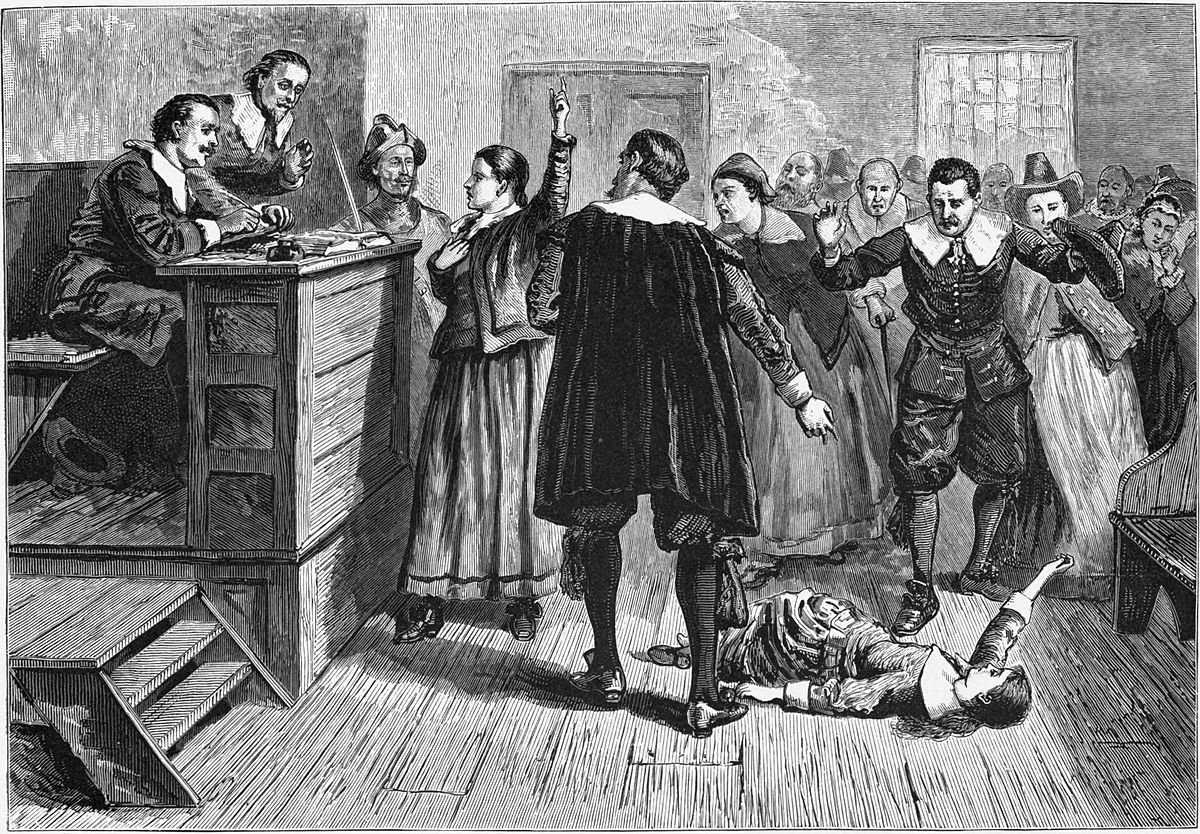
Basically, utopias want small-towns, villages, without all the yucky stuff, such as lack of diversity and, oh, witch trials. 

Because, yes, witch trials are more likely to come about in closed, insular environments than in open, cosmopolitan ones. 

One of the irritating aspects of both "it takes a village" leftism and "once upon a time, people were respectful and knew the difference between right and wrong!" right-Pollyanna-ism is the failure to allow that good thoughts by themselves do not produce well-working societies. There is a need for infrastructures. 

Diversity AND harmony don't come about by magic. They don't marvelously materialize because people who really, really want them run around saying so. In fact, diversity and harmony are naturally at odds, which is why dictatorships always revolve around removing choice.

As my Terry states, 

"True unlikeness bothers people. Pluralism pushes people’s buttons, which is why they always want something easier to manage. Diversity won’t stay put, different only to a point. Besides, no matter how many people are satisfied, any system will leave someone out. And that someone will complain."

Gilman, to her credit, attempted to create a fully diverse society with Herland. In fact, it is implied in several places that it is somewhat more diverse than even Gilman admits to her upper-class audience. 

The problem? As my Terry suggests, Herland wants the diversity to stay put, controlled, different only to a point. Not so diverse that the citizens will actually passionately disagree about, oh, abortion or vaccinations or individual rights or Motherhood or government or crime or punishment or religion...

Enough diversity to be admirable. Enough to show that the system works. But not enough to actually put anything or anyone at risk, to result in, say, witch trials or a turnover in leadership. Gilman, like many utopians, wants to split the good stuff from the bad without allowing for underlying principles--the very things that create the good stuff may lead to outcomes she doesn't want. 

So, for instance, Gilman presents education as exploration. For Anne of Green Gables lovers, Miss Muriel Stacy, the new teacher who inspires Anne to sit for her boards, is a great example of what Gilman argues for in Herland. Even Terry admits that allowing children to explore is better than having them learn by rout. And Alim confesses that although Terry's world attracts him, "his description of public and private schools, despite the sports, made my skin crawl." Gilman gives her young women comfortable clothes, a right to self-knowledge and individual person-hood. 

Yet Gilman fails to allow that such exploration and person-hood could lead a truly passionate young woman to question her society's boundaries, no matter how supposedly fulfilling.

My Moadine acknowledges Terry's point here:   

“Small desires lead to larger ones. A young woman who likes jewelry will eventually see such trinkets in entirely positive terms. Artistry. Beauty. Decoration. Genius. She will question why she should forbear having a child, someone with potentially the same interests and desires. She might even decide to keep that child close, raise it to her expectations, carry on her vision. Others like her might gather, perhaps form a guild. They might wish to bargain their creations for more materials. And if that justifiable request isn’t fulfilled, the young woman and her friends might question the workings of a society that diminishes them, keeps them from visions of excellence, honestly pursued.”

I [Terry] stared at Moadine, my hands hanging loose.

"Yeah, that,” I said, sounding like Alim. “Change, disagreement, varying opinions—they’re all inevitable. Only crazy people think a presidential election shouldn’t split a nation.”

Moadine knew about American politics by then. Not that she admired them—but who did?

I have Moadine go on to argue that culture--not force--keeps Herland's citizens from going too far: "The nail that sticks out gets hammered down." 

Moadine has a point. The problem? Powerful cultural expectations don't dovetail with the accepting, tolerant, and "roll with the punches" culture Gilman wants to create. Take into consideration, for instance, that many supposedly more "harmonious" countries than the U.S. have far stricter immigration laws. 

And Terry counters: "The squeaky wheel gets the grease." Eventually, always, inevitably, the culture changes. The noisiest, non-harmonious elements make themselves felt. 

(Thanks to Eugene for the comparison between the phrases!)

In fact, ironically enough, the search for answers (promoted by Gilman) can be part of a cultural upheaval that brings down a utopia. When that upheaval arrives, either top-down rules or in-place infrastructures prevent the whole thing going off the rails into anarchy. To avoid the use of the former (dictatorships quelling grassroots revolutions), the latter need to be in place already. Impossible to add them overnight.

Chapter 10

His in Herland or Astyanax in Hiding

The Problem of Nothing to Do

Fiction, poetry, art, even mythology pose a problem for utopians. Upholders of utopias supposedly like all that stuff (one is supposed to appreciate Art) but art has this difficult-to-monitor tendency to break out in unexpected ways. The Bible is a great example since no matter how many times people attempt to reduce it to a specific set of rules suitable to a specific social order, other people come along and said, "Hey, look! This story of Joseph--or Exodus--can be used in a completely different way."

Luther started a religious revolution and then lost his cool (which he never had much of anyway) when people said, "Oh, does that mean I can start my own religion!?" 

Consequently, many utopian so-called novels turn into polemics. Even Lost Horizon--which gets the closest to pure story--falters in the middle so Conway can reflect on the meaning of life. 

Preachiness is an aspect of the form. In fact, some utopia tracts are tracts, not novels. Even Samuel Richardson, while writing the Twilight of his day (Pamela), spent a great many chapters wittering on about social propriety and the role of servants, etc. etc. etc. 

The central chapters of Herland are almost entirely "here's how the society works" exposition as opposed to the novella's earlier action and dialog. 

I give a number of characters in His in Herland various reflections on life, religion, industry & economics, education. But I didn't want to lose sight of the narrative arc. I needed to add action! 

Terry was the action! 

Terry's disruptive influence is mentioned in the book, but Gilman restricts that influence to constant arguments between Terry and Alima. In the book, they are basically Ross & Rachel. 

The revolving door relationship actually makes sense but the lack of other avenues doesn't. It is unimaginable that the men wouldn't be put to work doing something. All those jobs Gilman pretends don't exist or, rather, pretends don't take time and grinding effort (as long as they are done by professionals), like washing dishes and changing dirty nappies. Hauling firewood or whatever fuel the country uses. Building stuff. 

Her men are products of their class and seem to take for granted that they don't have anything to do...so they hang out with their foresting girlfriends/wives all day.

Reality: nobody, male or female, agrees to be bored for that long. Victorian men going to their "clubs" without fail sounds impressively dull. Some men did do this, but many more were involved in philanthropic and scientific societies; the ones who weren't got into trouble with cards, duels, opium, and STDs. 

Van, at least, has the benefit of continuing his work as a sociologist and writer, but there is no good reason he couldn't also be put to work on printing or transcribing books. Doctor Jeff is not expected to keep regular clinic hours, and Terry--the planner and explorer (businessman)--is entirely at loose ends. 

In the central part of the novella, Gilman implies that the men are free to go where they want. There's no reason Terry couldn't simply walk away from (another) argument with Alima and start exploring the way he wants to. Yet he doesn't.

To forestall the obvious, I keep the men more monitored.

And I get Terry into trouble. In his own words, "I was getting ready to broach the subject [of Alim leaving] when I nearly blew everything by behaving like a character in a Rider Haggard novel."

Chapter 11 not only contains a scene of Terry getting into trouble, it challenges an utopian ideal, namely that removing ornamentation (jewelry, hair ribbons, makeup, sports apparel, etc. etc.) will also remove the desire to peacock. The women wear a kind of uniform (Van never notes any radical dissimilarities in dress). Herland heavily implies that the end result is more freedom of the self and equality.

Terry doesn't believe it.

Terry is (mostly) right, as an Ohio State University study discovered. And as Mrs. Pollifax notes in Mrs. Pollifax on the China Station, despite China being a supposedly classless society, demarcations of class are still noticeable: "[P]erhaps [Mr. Li's] attire wasn't modest at all, she thought, as she glanced around and compared him with the other Chinese waiting in line, for his sandals were leather, not plastic."

The individual wants to be heard.  The individual wants to do "my own thing," and should the individual get paid, the individual wants to spend that money on whatever the individual desires. 

No utopia can simply expurgate those impulses. No matter how abstract and philosophical utopians try to be, all those Rider Haggard behaviors--making the wrong things, pursuing the wrong ends, exploring the wrong places--keep throwing characters back into story. 

Thank goodness! 

Chapter 11

His in Herland or Astyanax in Hiding

The Problem of Art

I mention in the previous post that utopia novels or tracts tend to get a tad tedious--that is, they tend to turn into polemics rather than stay focused on story. The inherent fear of artistic license--that the novel or tract's readers will NOT react as required--creates texts in which the characters lecture others. In Gilman's text, they aren't even supposed to dress up, wear jewelry, and distinguish themselves visually

Here's the truth: Utopians fear art. 

Plato wanted to ban plays. Religious utopias waffle over holidays, maypoles, and the theater. Political utopias put comedy under fire.

Gentleman of Moscow by Amor Towles does an exceptional job painting the moral and artistic annihilations of the Soviet Union. (The protagonist's idealistic friend, who joined the new government, is eventually sent to Siberia for daring to assert in a memoir-type piece that Berlin bread--produced through the art of baking--is better than Russian bread.) 

As I argue in my thesis, a deep abiding fear of language--especially fiction--runs through all social orders. Every village, city, and state includes people who are sure that nobody else gets "the joke":  irony, satire, puns, riddles, tall tales, gags, farce, punchlines, knock-knock jokes. Such people tend to be rather humorless anyway--and they often substitute "teasing" for true humor--which makes one wonder if they don't get the joke. 

They will never admit it. Everyone else is completely helpless in the face of exaggeration, nuance, context, non-lecturing literature, flights of fancy, dreams. Everyone else must be protected against such dangerous stuff.

I wish I could argue that all these folks come out of the "special knowledge" Ivory Tower left, a bunch of academics divorced from reality shaking their fingers at all those people bamboozled by the companies and studios that the academics don't approve of. And these academics exist!

The truth is, however, that anyone in any field is capable of feeling that other people have missed the point and must be harried until they are "fixed" of their bad thoughts--inoculated against so-called bad opinions, attitudes, art--at which point the penitent will be allowed to return to the fold. 

In my experience, the harriers or sermonizers are practicing a kind of transference. They are quite susceptible themselves to trends and fads. As the C.S. Lewis quote indicates, they are terrified of appearing "uncool"--not unlike teenagers who group together for protection against anything that differs from the group. It takes time and moral growth to do what they love, not what is "approved."

In Chapter 12 of His in Herland, Alim and Celis discuss folklore. Celis argues that the mentors want to produce "goodness" at the expense of creativity. (My Celis is rather hard-headed and practical. Here, she is observing, not necessarily starting a revolution.)

I [Alim] protested. People innovated. They improved machinery. They came up with new educational methods.

“Not outrageously,” Celis said. “Why do you think the old stories are never told in Troas’s theaters? The ones with unkind parents, brutal kings, devouring monsters? Wars. Famine. Fallen cities. The mentors draw lines. There’s an edge to the world. If we fall off it, we’re lost.”

“People tell the stories anyway.”

“Sure. But the fear is always there. Nobody, not even your Terry, believes someone can explore an idea and not become it.”

“Maybe they do become it. I met Terry and now—” Now I know what I don’t have. Now, I'm considering what else might be possible. 

Celis said, “You can’t be the hero and the villain and the monster and the deviant all at once. Not in reality.”

Unless people are heroes and villains and monsters and deviants all in one.

In the end, no matter what Utopians try, fiction is inherently uncontrollable. Its goal is to lie, enchant, bamboozle, astonish. Its prevalence suggests that human desires precede the supposed ideals of human religious, scientific, economic and political systems. If human desires come first, seamless order will never be entirely possible, no matter what leaders force onto people. Compromise is the only solution. A utopia will always fracture and dissolve. 

One of my favorite movies, Galaxy Quest, contains one of my favorite scenes: Tim Allen's character has to explain to the alien commander that his show (a take-off of Star Trek) is a fabrication ("Explain it to him in words a child could understand"). The character is deeply apologetic.

Yet, at the end of the movie, Galaxy Quest: The Television Show has been revived. The dangers of fiction are weighed against its joys and found less important, not because the dangers may not exist but because a world without fiction is dull and empty and robotic and non-human. It is a world run by lecturing woke academics and offended humorless moral leaders--that is, well-meaning members of any field or group who feel the need to "enlighten" everyone else and manage their intake. (Literary Weight Watchers.) 

Woe to that generation that replaces our superficial, tacky, sometimes downright stupid television programming with high-minded dramas addressing issues of class, race, orientation, and gender alongside accompanying disclosures of said dramas' underlying ideologies ("triggers") as well as their purposes and applications. A curse upon your heads! (I wrote parts of this post several years ago. Rereading it, I felt positively prophetic!)

When it comes to fiction, the important questions are: Do we viewers/readers believe? Does the story work? Do the characters live for us? Do we care about them? Are we carried away by the story? Are we satisfied?

Leave the "I'm SO appalled" attitude to the sermonizers. Leave the fun of the thing to the rest of us. 

Chapter 12

His in Herland or Astyanax in Hiding