Showing posts with label Bullying. Show all posts

The Problem of Bullying

Many utopias purport not to need a police or other type of civil force. Citizens are described as complying with the society's blueprint. Something as basic as More's city-dwellers NOT agreeing to move to the countryside for 2 years is never addressed (or even contemplated). Goods NOT being automatically distributed as expected is also never addressed. 

The non-compliant behaviors aren't crimes, not by any credible moral standard. Suppose a city-dweller decides to leave the countryside before the 2 years of required labor are up? Suppose a city-dweller doesn't agree to give up a garden plot after the allotted time? Or an artisan doesn't want to leave one family to live with another as expected? 

The narrator claims that there are few private disputes in Utopia, which "observation" doesn't correspond to any human society that has ever existed in the course of history. 

Granted, More's Utopia is partly a thought experiment--but one imagines that a thought experiment would include some way to enforce the expected social customs/structure. Faced with how often human beings would fall short in More's Utopia, how could it possibly be kept going as described?

There are only two ways: totalitarianism or stigma/condemnation. 

More falls back on a combination. The ultimate punishment is in fact death--first, the malefactor (breaker of customs) is placed into slavery (from which the malefactor can be pardoned), but if the prisoner/slave continues to rebel, the slave is killed. (How slaves are monitored is bypassed: the necessary number of guards is never addressed.)

The section on Punishments and Rewards, however, focuses more on condemning bad behavior (what must not happen) than on establishing laws. The virtuous are rewarded with accolades while the threat of possible stigma lurks around every corner (social media, anyone?). Citizens, for instance, can eat at home rather than in communal cafeterias but "no one does it willingly because it is not thought proper...besides, it would be stupid." 

Guess all us homebodies will have to go live in one of the colonies (thank goodness!). 

Many utopias disguise this inherent bullying with assumptions of compliance. They then rave about harmony and beautiful vistas, rather like small-minded American idealists being ushered about by bored Soviet hospitality managers. Oh, my, everything looks so nice--how can Reagan be so critical of the USSR?! (See PJ O'Rourke's Holidays in Hell.)

In Chapter 3 of His in Herland, I have Terry make the following point: 

"To be held inside walls without consent is imprisonment, however beautiful the walls or pleasant the food." 

In Gilman's Herland, the three men are taken captive by a cohort of tough, athletic women, about forty in number. Terry is carrying a gun but shoots over the women's heads. Interestingly (and I think correctly), Gilman has Terry balk at shooting the women directly. He is a product of his nineteenth-century upper-class culture. "Women and children first" was not quite as common as popular culture likes to argue (on the Titanic, most of the crew simply wanted passengers, any passengers, to get in the lifeboats). But the concept existed. Terry, for all his faults, is a man's man. He won't shoot women. He won't shoot anyone in the back. 

I took the guns away since my Terry is somewhat more cool-headed and slightly more ruthless--and is perfectly aware that women can be soldiers.

However, I also have my Terry "pull his punches" in the confrontation with the women. The men have arrived on the island/in the country, imagining they are tourists who will be shown the nearest hostelry. The women see them as invaders and behave accordingly. Terry doesn't want to start an international incident.

Gilman gives the women a bland, remorseless demeanor, but she also tries to present them as non-violent. It isn't...force! Oh, no! It's a kind of...herding...

Gilman is a good writer--a point I will refer back to later--and I want to give her her dues. But Terry is my truthsayer and the truth is...Taking people captive is taking people captive. 

Bullying is bullying.

One of the worst aspects of modern-day bullying is when people argue that their "niceness" or "good intentions" or "high-mindedness" or "identity" or, for that matter, other people's bad behavior/thoughts somehow wipes out the fact that they are using underhanded and cruel techniques to accomplish actually nasty things: take away people's jobs, smear their reputations, steal their life's work, commit violence against them, and attempt through various venues to cow them into submission. 

It's jealousy and small-mindedness under a veneer of benevolent righteousness. 

Likewise, taking people captive--while it might be justified--doesn't transform into something else simply because it is labeled something else. Violent or not, justified or not, the women ignore the men's human rights and put them in the equivalent of prison. 

In Herland, Van, the social scientist, tries to to explain everything (away); Jeff, the chivalrous, well, boob, thinks the women are pure and noble simply for being women. Both try to excuse the women's behavior by labeling it something else. Only Terry sees it for what it is--and he respects it. 

Elizabeth Bathory
To her credit, while keeping Terry somewhat more obnoxious than even I can stomach (but appropriate to his time frame), Gilman allows that Jeff, at least, is off-base. 

As my Terry states in the next chapter:

"Hopefully, the women’s agenda wouldn’t entail screwing us before chopping off our entrails or sending us on suicidal missions against a prowling enemy or playing games with our disemboweled guts or mounting our decapitated heads on spikes." 

My Terry knows more history that Gilman's Terry. Everybody has the capacity to be nasty. Someone doesn't instantly stop being a bully because that someone is female or the upholder of a utopia or because the behavior is labeled something else.   

Chapter 3

The Problem of Chronocentrism: Part I, The Past is Entirely Awful

Chronocentrism has two aspects. Nobody captured both aspects better than Charles Dickens:

It was the best of times. It was the worst of times. 

Utopias tend to present this classic reflection as follows:

It was the worst of times but it produced us, the best of times, to fix everything. 

In sum, utopian chronocentrism determines that thousands and thousands of years of human experience have culminated in a bunch of people who define the universe as being entirely about themselves.

Trickle-down CRT is enormously distasteful precisely for this reason. If you are confused why any group of people would voluntarily agree to be absolute enemies in someone else's narrative (rather like acquiescing to an emotionally abusive relationship), the explanation here is ready-made: 

It puts that villainous group at the center of everything.

And since the bad behavior on the table is entirely theoretical (and uncontrollable), it places the real pain and horror--as well as any real responsibility--at a distance. People actually believe that adopting the right terminology is the equivalent of "doing something."

It isn't.

Chronocentrism is one reason my church lost its cultural hold on me fairly early. I couldn't buy into the idea that I was a member of a "special" generation. I didn't want to be. And the more I learned about history, the less I thought I was. Moreover, there are few things as distasteful as sitting in an air-conditioned (if slightly smelly) or heated (slightly smelly) church building with scores of paid-for cars outside in the parking lot while well-fed people who live in houses and apartment buildings, some on assistance, some not, complain about the evil world in which they live and how bad everything has gotten. We live in the end of times! Everything was waiting for US to come along and point it out!

The idea that all life has been leading up to "now" is a patent, egocentric falsehood. 

First, the Worst of Times

True, history is full of bad stuff. In pre-written-history, a single skirmish led to the elimination of an entire clan. The child mortality rate was incredibly high. For most of history, healthcare, for all people, was more or less a crapshoot--though people were trying. Medical conditions, ones that appall us now, like dying from rabies, dysentery, and blood poisoning, were commonplace. Plagues/pandemics didn't just shut down businesses for a year. They wiped out 2/3rds of the population and changed the economic and often the political landscape forever (such changes are, to an extent, still true: that is, disease and volcanoes do more than theory to alter social orders). 

Few people, men, women, minorities, non-minorities, had rights. Most people worked on farms/the land, which doesn't mean they didn't have individual problems and romances and ideas. But we don't know because most of them didn't write stuff down. They couldn't write. For most of history, most people couldn't write and most of them couldn't read, and that statement includes royalty. 

Children worked and the ones who didn't were treated like pawns to be moved around a chessboard. Conscription was a regular occurrence. Debtors' prisons were a reality. Slavery existed on every continent--and for most of history, it included most populations. It varied in practice. It was still a given.

The variety of food in our current culture simply didn't exist. People ate so they wouldn't die, not for the sake of a "balanced" diet. Many leaders deliberately starved members of their countries up to and beyond Stalin's Russia. Destroying a country's agriculture--salting the earth--in battle was considered a norm.

Death by hanging was commonplace and issued for multiple infractions, most of which we would consider minor. Death by guillotine was considered kinder. Torture was considered a legitimate investigatory device, not something to be debated or prevented.

There was no such thing as a free press. The left and right's use of "news" for political ends was commonplace. The world was Twitter--only slower on the dissemination end. Sex in office, fraud in office was business-as-usual.

And I could keep going... 

Despite all the negativity, in all time periods, people have...well, okay, yes, a lot of people thought they were living at the end of everything. But they weren't. And a lot of them simply kept going. Moreover, they defined the world about them in terms of THEIR standards, not in terms of ours (just as we do, as a matter of fact). 


And yet, many utopias maintain that nothing has gotten better and/or nothing has ever been as awful as it is now and/or nobody recognized the awfulness of the world until now. 

Why? 

To be continued... 


The Problem of Art

I mention in the previous post that utopia novels or tracts tend to get a tad tedious--that is, they tend to turn into polemics rather than stay focused on story. The inherent fear of artistic license--that the novel or tract's readers will NOT react as required--creates texts in which the characters lecture others. In Gilman's text, they aren't even supposed to dress up, wear jewelry, and distinguish themselves visually. 

Here's the truth: Utopians fear art. 

Plato wanted to ban plays. Religious utopias waffle over holidays, maypoles, and the theater. Political utopias put comedy under fire.

Gentleman of Moscow by Amor Towles does an exceptional job painting the moral and artistic annihilations of the Soviet Union. (The protagonist's idealistic friend, who joined the new government, is eventually sent to Siberia for daring to assert in a memoir-type piece that Berlin bread--produced through the art of baking--is better than Russian bread.) 

As I argue in my thesis, a deep abiding fear of language--especially fiction--runs through all social orders. Every village, city, and state includes people who are sure that nobody else gets "the joke":  irony, satire, puns, riddles, tall tales, gags, farce, punchlines, knock-knock jokes. Such people tend to be rather humorless anyway--and they often substitute "teasing" for true humor--which makes one wonder if they don't get the joke. 

They will never admit it. Everyone else is completely helpless in the face of exaggeration, nuance, context, non-lecturing literature, flights of fancy, dreams. Everyone else must be protected against such dangerous stuff.

I wish I could argue that all these folks come out of the "special knowledge" Ivory Tower left, a bunch of academics divorced from reality shaking their fingers at all those people bamboozled by the companies and studios that the academics don't approve of. And these academics exist!

The truth is, however, that anyone in any field is capable of feeling that other people have missed the point and must be harried until they are "fixed" of their bad thoughts--inoculated against so-called bad opinions, attitudes, art--at which point the penitent will be allowed to return to the fold. 

In my experience, the harriers or sermonizers are practicing a kind of transference. They are quite susceptible themselves to trends and fads. As the C.S. Lewis quote indicates, they are terrified of appearing "uncool"--not unlike teenagers who group together for protection against anything that differs from the group. It takes time and moral growth to do what they love, not what is "approved."

In Chapter 12 of His in Herland, Alim and Celis discuss folklore. Celis argues that the mentors want to produce "goodness" at the expense of creativity. (My Celis is rather hard-headed and practical. Here, she is observing, not necessarily starting a revolution.)

I [Alim] protested. People innovated. They improved machinery. They came up with new educational methods.

“Not outrageously,” Celis said. “Why do you think the old stories are never told in Troas’s theaters? The ones with unkind parents, brutal kings, devouring monsters? Wars. Famine. Fallen cities. The mentors draw lines. There’s an edge to the world. If we fall off it, we’re lost.”

“People tell the stories anyway.”

“Sure. But the fear is always there. Nobody, not even your Terry, believes someone can explore an idea and not become it.”

“Maybe they do become it. I met Terry and now—” Now I know what I don’t have. Now, I'm considering what else might be possible. 

Celis said, “You can’t be the hero and the villain and the monster and the deviant all at once. Not in reality.”

Unless people are heroes and villains and monsters and deviants all in one.

In the end, no matter what Utopians try, fiction is inherently uncontrollable. Its goal is to lie, enchant, bamboozle, astonish. Its prevalence suggests that human desires precede the supposed ideals of human religious, scientific, economic and political systems. If human desires come first, seamless order will never be entirely possible, no matter what leaders force onto people. Compromise is the only solution. A utopia will always fracture and dissolve. 

One of my favorite movies, Galaxy Quest, contains one of my favorite scenes: Tim Allen's character has to explain to the alien commander that his show (a take-off of Star Trek) is a fabrication ("Explain it to him in words a child could understand"). The character is deeply apologetic.

Yet, at the end of the movie, Galaxy Quest: The Television Show has been revived. The dangers of fiction are weighed against its joys and found less important, not because the dangers may not exist but because a world without fiction is dull and empty and robotic and non-human. It is a world run by lecturing woke academics and offended humorless moral leaders--that is, well-meaning members of any field or group who feel the need to "enlighten" everyone else and manage their intake. (Literary Weight Watchers.) 

Woe to that generation that replaces our superficial, tacky, sometimes downright stupid television programming with high-minded dramas addressing issues of class, race, orientation, and gender alongside accompanying disclosures of said dramas' underlying ideologies ("triggers") as well as their purposes and applications. A curse upon your heads! (I wrote parts of this post several years ago. Rereading it, I felt positively prophetic!)

When it comes to fiction, the important questions are: Do we viewers/readers believe? Does the story work? Do the characters live for us? Do we care about them? Are we carried away by the story? Are we satisfied?

Leave the "I'm SO appalled" attitude to the sermonizers. Leave the fun of the thing to the rest of us. 

Chapter 12

His in Herland or Astyanax in Hiding 

The Problem of Self-Fulfilling Labels

One issue that I faced with my male Alim in His in Herland was,  

Why should he have to hide? 

The male intruders--Terry, Van, and Jeff--don't. So why Alim?

Interestingly enough, the answer lies in the underlying "forward-thinking" ideology of most utopias. 

In Gilman's Herland, Terry, Van, and Jeff are treated as representing a current, contemporary, forward-moving culture. Van is embarrassed to admit how much society has not advanced (considering that the world was on the brink of World War I, "not advanced" is something of an understatement). Jeff is gleeful at the comparisons that put American/European society in the wrong. Terry doesn't care, except he wants to leave. 

The leaders of Gilman's Herland monitor and supervise the men throughout their stay, though Gilman pretends they don't. They are never given any "legal" rights, such as voting or governance--not even the equivalent of driver's licenses!

The implication is that Van and Jeff, at least, have progressed far enough, they can be "educated" to the new way of living. Terry is a throw-back and therefore ungovernable and unmanageable. In the book, when Terry attempts to rape his wife, Alima, the answer is either to eject him or kill him. Moadine pronounces that death would be "kinder" than locking him up. 

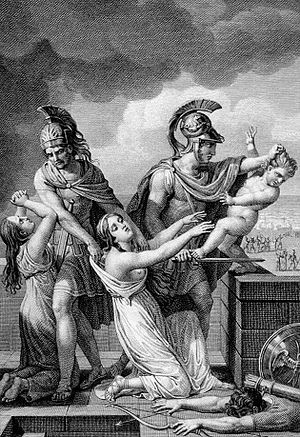
In one version, Astyanax
is thrown from Troy's walls.
In my version, of course, Terry never goes that far. His exile is planned with Alim's help. 

But the leaders' reaction to Terry in Gilman's book--and Gilman's praise of eugenics (and Gilman's later sanguine acceptance--alongside other intellectuals of the time--regarding WWI's "purging") shadow the dangers to Alim. Alim is a literal representative of the unprogressive mindset. He is Astyanax, Hector's son, a lingering remnant of the so-called evil past. 

For a culture that believes in "breeding," Alim would be a throwback. After all, at the end of the book, only supposedly completely progressive Jeff actually breeds in Herland. (Van and Ellador leave, then return.)

As my Moadine points out to my Terry (she is as ruthless as Gilman's Moadine):

“You three men are acknowledged intruders. And, too, your presence has temporarily quelled questions about the ‘other sex.’ But Alima, Alim, is a citizen. Any restrictions on him would be resented—by Alima and by his friends. He would be defended. But yes, some citizens would wish to send him away—because of his past, because he represents going back rather than forward.”

Astyanax, Andromache & Hector

“He is a boy, not a symbol. What kind of society is this that you can’t incorporate him?”

“The truth of him would cause conflict.”

“You think conflict won’t arise anyway? You think male distinctiveness is the only distinctiveness? Suppose Celis was more of a go-getter? You really think Tyra and others could keep her in place?”

The smallest smile touched Moadine's lips. “No. But destruction is always to be deplored. Should we start that battle now?”

Over one boy, a boy who could be persuaded to leave.

The argument here is between the reality and the label, or, rather, self-fulfilling label. As with all utopias, the problem is created by the utopia itself. 

If a society determines that certain people are "good mothers" and certain people are "bad mothers"--if it focuses on breeding as a way to remove the criminal element from human nature--if it insists that human nature must "progress," not in terms of functional governments and intelligent policies but in terms of inherent human nature--the enforcement of that mindset will follow. Tolerance ends at the point where "primitive," non-progressive, very human nature rears its head. It isn't supposed to return! Therefore, it must be eradicated! 

Rather than a frank and honest appraisal of human nature, labels become judgment--and self-deception. Terry's crime in the book is unacceptable (as my Terry acknowledges). The utopia's downfall arises not from Alima's reaction--and Terry's exile--but from the surprise of the entire society that the label (we are a self-congratulatory pristine society who exercise the following advanced philosophies) didn't carry more weight than the circumstances. No infrastructure or law exists to handle the circumstances because, well, really, those circumstances shouldn't have arisen at all, now should they have?

Human nature is the battleground that utopias can never overwhelm and scorch from existence. The attempt to do so anyway--rather than accepting human nature as part of the equation--creates outcomes that far outstrip human nature in viciousness. Utopias are, in sum, dystopias in waiting.    

Chapter 14

His in Herland or Astyanax in Hiding

The Problem of Chronocentrism: Part III, Labels versus Thought

"[T]he public, the populace, the citizenry,
must be provided with the correct
feelings! Sentiments...are insisted upon
in all public utterances."

In Chapter 15, Terry convinces Alim to leave Herland or Troas. He also determines to get himself chucked out by breaking taboos.

As Alim states, 

Terry was convinced that he needed to...force the leaders to deal with him as a malefactor or transgressor.

In retrospect, the plan was unbelievably risky. Any culture—no matter how polite and so-called civilized on the surface—can descend into anarchy and witch trials.

Not that I knew that then. To a coddled teen, Troas appeared entirely predictable. Boring. To Terry, it appeared merely restrictive. Both of us were tempting fate, Terry especially. He was hoping for exile. He could have gotten worse.

And as Terry states,

Bureaucracies are the same the world over. The leaders were discussing us—or, maybe, just me. Jeff wanted to stay in Troas. Van would stay or go to be near Ellador. In the meantime, there was no indication the leaders would encourage or allow or permit (whatever terms dictators use to convince themselves of their compassion) such a dangerous, unworthy, harmful course of action as Ellador or Alim leaving Troas.

The tension here is between the reality of the utopia and what it pretends about itself.

Chronocentrism, Part III

 The ego-centered belief that we suffer more than our ancestors is irritating.

The ego-centered belief that we have progressed far beyond our ancestors is more understandable. It is still incredibly self-centered. 

Progress does exist. Medicine. Education. "Givens" regarding rights. The early years of the Common Era produced fresh ideas about the individual and God, ideas which filtered across many cultures and greatly improved conditions for individuals everywhere. As Rodney Stark points out, the Dark Ages are only dark because of how little we know. In general, life got better when the Common Era hit.

The arrogance comes into play not so much with the material goods and opportunities that we've gained. Those should entail a humble response: I'm so glad to be alive now! The arrogance comes into play when people in the past are treated with smug contempt. 


The smug contempt sounds something like this: 

"Those primitive ancestors of ours didn't know any better when it comes to science and religion and the social order. We do. We are moving forward, beyond their silly thoughts and clearly shallow thinking based on our advanced theories and our talent for maintaining those advanced theories! We don't even have to refute those idiots of the past. We just have to roll our eyes over them like high schoolers at the prom. Har har har. Let us contemplate our magnificence!" 

Herland rests on the above thinking--to an extent. Gilman's perspective is rooted in nineteenth-century Progressivism; the mindset--we have progressed beyond our backwards ancestors--shows up in Victorianism even before Darwin. (Evolution as progression wasn't his precise argument, but what people thought he was saying fit well with the ethos of the time.) It continued until two World Wars turned it into a nonsense. It is now back in a slightly different guise. 

The problem is not that the world isn't materially better (despite all the bad stuff) than it was thirty to fifty to a hundred years ago. The problem is the adoption of a label or attitude: "Because I'm not as backwards as they, I'm automatically better and don't have to consider anything other than congratulating my bubble existence and echoing what my group/clique/mob says." 

This we're-so-much-more-thoughtful-and-cultured-and-insightful insistence shows up in every area of life (not just politically-focused social media, though it flourishes there). A few years ago, I encountered an article by a woman proclaiming how far she has risen above the backwards theological assumptions of her church: In this day and age, sin and guilt are such déclassé concepts! So tacky! I'm beyond all that!

Okay, was my thought. What do you have to offer?
What she had to offer were ponderings from her naval; big thoughts about the nature of the universe based on..."MYSELF" (I'm not kidding).

Not exactly Thomas Aquinas.

Gilman goes down the road of the aforementioned me-myself-and-I writer. In fairness, Gilman argues that just as the current generation of Herland's citizens is building on the ancestresses' achievements, so shall the next generation build on the current leaders' achievements. She acknowledges that their ideas (Gilman's ideas) might prove to be lacking--which is good, cause they were.

And she argues against infant damnation, which is a positive.

The problem, as my Celis character points out, is that Gilman doesn't argue against infant damnation using logic, faith, or, simply, a better idea--as plenty of people did, including Joseph Smith. She argues against it by having Ellador break down in tears (again, I'm not kidding). In His in Herland, Alim and Celis have this exchange: 

I [Alim] never paid much attention to Ellador and Van’s philosophical discussions. I shrugged. 

Celis said, “Van, bless him, tried to explain to Ellador about infant damnation. It’s a belief from the other world’s history. A belief that unbaptized children—children who are not inoculated against the sins of their ancestors—are doomed to hell.” 

“That’s unpleasant,” I said. 

“Of course it is. But it’s part of a bigger theology. Religions are complex. People are complex. Understand the idea, understand how people think. Then, you can challenge the religion or the philosophy directly. Yet Ellador ran off in hysterics to a Temple Mother.” 

Celis’s tone was fondly exasperated. 

“And of course, the Temple Mother told her, No, no, that sort of thing can’t be true. Only ignorant people ever believed it. Ellador’s no fool. She realized immediately that dismissing the idea wasn’t going to make it easier to grasp that big picture she’s always pursuing. She should have known better than to run to someone who wouldn’t talk to her as honestly as Van. But she did. That’s why mentors like Tyra put up with her. Because Ellador is appalled by the right—or, rather, wrong—things. She’s offended when appropriate. Appreciative when appropriate. She’s a ‘good’ girl.”

In other words, Herland's religion has nothing to offer in the place of Presbyterianism, not even anything as witty as Twain's quote. It offers a kind of generalized "we're better" self-label, a kind of "in" group culture filled with rules, cultural appropriateness, and "good thoughts." It's entirely substanceless, in part because it rests on the premise that it doesn't have to justify itself. The quality of being advanced is supposedly enough.

The end result of such smug self-satisfaction (I'm upset about the right things! I curse the right things! I hate the right people! I cry at the right times! I embrace appropriately worthy people and ideas!) is a remarkable lack of critical thought. That is, the pretense or performance or presentation--Look at our wonderfulness!--is more important than thinking about...anything, really. 

My personal theory is that Utopians are actually hunting for safety.  In truth, I'm not sure they are even aware that under all of the boasts of advanced thinking and edgy ideas, they are in fact...

Intensely reactionary, the kind of reactionary that belongs in countries run by dictators and religious oligarchs. It is less about holding the course (conservatism) or respecting the individual (classical liberalism) and more about retreating to something almost entirely imaginary based on an almost entirely constructed imaginary past.

Take the current so-called "revolution" on gender. The end result is not a broadening of gender or understanding of human self-perception and sexuality but, rather, "girls must like pink stuff and dolls" while "boys must like trucks and sports." In the meantime, schools that push pronouns on little kids create psychological havoc. Kids are fully capable of liking multiple things at once. Being forced to parse dinosaurs, sports, and unicorns is, to them, weird. 

They are right. It is weird.

My generation asked questions like, "Is it okay for men to cry?" and "Hey, what about women astronauts?!" Simplistic maybe, but we were headed in the right direction. Expand, not retract.

The categories being fed these kids are more reminiscent of Victorianism than anything in the last fifty years. 

Gilman does the same. To be honest, I've never fully understood her take here, since she suffered post-partum depression after the birth of her daughter and wasn't really an Earth Mother type. Yet Herland is entirely devoted to a gender imperative. The purpose of women is Motherhood, and yes, the "m" is capitalized in the book. 

Perhaps Gilman felt guilty about her own lack of motherliness. She may have embraced the idea of Utah polygamy whereby a woman could go to college while other women watched her kids. Or perhaps Gilman wanted to make her utopia palatable to her audience. Or perhaps she truly embraced the idea of improving future generations: bringing up children should be done right. (Her daughter and she had a strained relationship, which isn't made more understandable by recent scholars wanting the daughter to have had a different attitude towards her "great" parent than she actually did or cared to have or thought about.)

To Gilman's credit, she pairs Motherhood with Fatherhood. 

And Terry objects. 

Interestingly enough, although his objections in the book are portrayed as somewhat sexist, they resonate with a modern audience. When he proclaims, "What a man wants from women is more than all this Motherhood," he sounds like a feminist!

His objections to Fatherhood are equally strident. 

Terry is arguing for the individual. 

So many utopias falter on the need to tell citizens what roles they must adopt. Like dictatorships and American Ivory Towers, utopias really like the idea that people have been properly pigeonholed.  

In reality, revolutions are often far less "new" than they like to pretend. 

Chapter 15

His in Herland or Astyanax in Hiding

The Problem of the Closed Narrative or The Problem of Theory

On the surface, identity politics shouldn't be evil. Although I'm not a fan of labels, hey, language is language. It has to exist for people to communicate. Identifying a group is part of that process. (Historically speaking, "stranger" shows up in nearly every language early on in that language's development.)

Unfortunately, inevitably, identity labels get linked to a "closed" narrative, a story that is self-explanatory and set in stone.

An "open" narrative in which people may change based on new information, new goals--where to live, whom to marry, what to work at, what to eat, how to behave--entails two things: (1) risk; (2) responsibility.

That is, a person in an open story will say, Maybe I made the wrong choices. But I made them, and I can't go back, so I'll live with them. But what does that mean for the next choice? After all, I'll have to answer for it.

The popular version of CRT--the secular version of "the Spirit made me do it" (John McWhorter is right about the religious conflation)--is the exact opposite. The underlying ideology propounds that a theory or label supplies all the explanation a person should need or want; recognizing the validity of that explanation will, like recognizing the Spirit, supply all the required (entirely abstracted) sense of self and responsibility. 

Unfortunately, as Jonathan Edwards and other New Calvinists discovered, all the revivals in the world don't necessary lead to anything but...another bunch of revivals. The experience or "performance" becomes its own pursuit.

That is, adopting the group's identity or explanation doesn't automatically entail self-understanding or critical thinking or personal change or long-term change. 

In Chapter 17, Terry is on trial for his attempted assault on Alima. In my version, of course, the assault is a contrived event between Terry and Alima. However, Terry objectively accepts that by all appearances, he did break the law, violate a social standard. 

During the trial or hearing, Terry suggests a reason why people so readily adopt theory--ready-made identities--when life--relationships, communication--gets messy. 

I [Terry] said [to the Councillors], “I assumed agreement existed.”

Rather to my surprise, many of the Councillors nodded. Apparently the “you should ask at every stage of the seduction” approach hadn’t arrived in Troas.

Of course, the women of Troas are realists. People make assumptions about others’ needs. That’s life. Since we are not (yet) tools of A.I., we don't spend every minute of every day filling out questionnaires: check Box A or Box B.

No one wants that form of communication anyway. We want to be instantly understood—the centers of others’ universes—which wish inspires its own problems. Because--also reality--since we don’t adopt others' versions of our best selves, why would they agree to ours?

I waited resignedly for the Councillors to suggest the contemporary alternative. Since most people don’t halt their behavior to ask permission—and only compulsives and high school bullies justify continual “I saw you do that!” policing—the compromise is usually, “But the proper path should have been obvious."

Not obvious due to honor or training. Obvious because of identity. Join the group, adopt the designated label. Proper attitudes will be downloaded into your brain. All answers delivered. All stories decided upon. A closed book.

Don’t tell me modern Westerners don’t believe in fate.

Terry goes on to consider that being excused because of membership in a group sounds good but lacks the moral punch of "you messed up; you should pay." 

And Terry gets thrown out. Luckily, he wants to go. 

Chapter 17

His in Herland or Astyanax in Hiding

The Problem of How to Get Out

Utopias are not automatically closed environments. However, leaving a utopia is almost always difficult. In Lost Horizon, despite continual warnings, Lo-Tsen (book)/Maria (movie) leaves Shangri-la, whereupon she immediately dies from old age--after a tremendous number of people are killed in an avalanche (movie).

Even when the risk isn't physical, the communal pressure to remain can be tremendous. The underlying justification of all utopias postulates that it's so exactly what humanity needs, anyone who wishes to leave must be damaged in some way. The damaged person either needs to be fixed or expelled. 

The practical problem--and one explanation for the knee jerk negativity--is that a loss of citizens requires restructuring of the remaining social order. 

I propose a still older explanation. Utopias often bleed into the fairy realm, and leaving the fairy realm always requires payment: 

Tam Lin transforms into various animals, Rip Van Winkle--and others--lose time. Eurydice can only leave the Underworld if her lover performs a task. 

Tasks often involve sacrifice. As Terry says in Chapter 18, "I was here in the tunnels to take risks."

I support this particular trope. A change in life brings along costs. It requires that the protagonist delivers up something of the self. Alim, a citizen of Troas in His in Herland, accepts that he may never be able to return. He "acts on the world," choosing to leave rather than simply follow Terry's lead (Terry sacrifices his reputation--such as it is--for the ability to leave).

Writing problems arise when writers don't want their protagonists to take this risk. 

The writing problem doesn't appear to be attached to suffering. Suffering delivers cache. Rather, writers come across as reluctant to force their protagonists to live with a choice. Perhaps writers fear having their protagonists make the wrong choices. Perhaps writers don't want their characters to have to choose. 

Nevertheless, it must happen. Keeping one's options open is hardly the point. The protagonist accepting responsibility is the point. 

I recently read a disappointing Christmas story. In the story, the protagonist--who went into a series of foster homes when his mother died--learns that his father is a substitute Father Christmas, an elf who filled in for Santa one night. 

Not a bad premise. (I'm not troubled by overdone premises.)

Unfortunately, however, the writer wanted the foster situations that the protagonist suffered to be horrible. Look at all that suffering! 

Except then, the writer wanted to let the substitute Santa off the hook. The biological dad couldn't check in on his son because...ah...he was afraid he wouldn't be able to get back to Santa's world...except people can...so...he was afraid Santa would be mad...except Santa is a really swell guy...but it's nobody's fault and nobody's responsibility because the substitute Santa lives in another world...except the protagonist can visit...only the substitute Santa can't leave...except people do leave all the time...and by the way, the protagonist is about thirty, so the substitute Santa had three decades to overcome all the waffling. 

And the telephone system blew too--
amazingly enough.
It reminded me of Tom Hanks' character in You've Got Mail trying to invent reasons for his supposed no-show. 

I was disgusted. The protagonist's father abandoned his son and had no good narrative reason not to check in on him for thirty years. 

If a protagonist is going to abandon responsibility, the reason had better be a good one ("God" or "my clique" or "the social order told me too" or "I must for the sake of a perfect future" is not an acceptable reason). Otherwise, the protagonist needs to step up. 

In a sense, I've come back to where I started with these posts: to keep people in (isolated), there has to be a reason--and it has to be believable. If people determine to leave, they must bargain with the world's rules or--in the case of Terry & Alim--the Fates. 

As one of my Greek gods tells Terry, “Everyone’s story has to be checked.”

Terry arrived through the tunnel--Alim and Terry leave through the tunnel after paying a toll: Fantasy Writing 101. 

Chapter 18 & Chapter 19

His in Herland or Astyanax in Hiding

The Problem of the So-Called Right Side of History

A great many problems with the utopia come down to the idea that there IS a right side of history. 

It's an idiotic concept.

I am not suggesting that right and wrong don't exist. I am suggesting that the phrase is loathsome and mindless (no matter how the phrase is interpreted: the "right" side of history is the side that will win, become popular, be obviously correct to future generation or the side that should win).

The phrase is loathsome and mindless for the following reasons:

1. Babies and bathwater 

Good events and values and outcomes rarely come un-entwined with other stuff. 

There's a great Black Adder episode in which an election takes place. It is the Regency Era and one of the candidates wants "the ending of slavery and the compulsory eating of asparagus."

The reporter says, "I understand your point about asparagus but what's up with your stance on slavery?"

The (entirely historically accurate) point being made is that many people (Abolitionists, Millennialists, and Reformers) in the same era had what we moderns would deem rational and valid ethical points about the treatment of others. Unfortunately, they tended to combine those rational and ethical points with ideas that strike many modern folks as...nuts--such as the compulsory eating of asparagus.  

Likewise, advancements that strike people as utterly rational will get paired with ideas that MIGHT seem valid at the time but in the end turn out very much not to be--such as the pairing of birth control with eugenics in the early twentieth century.

2. Chronocentrism

How much is the "right side" based on perception?

I mention elsewhere that Ancient Athenians in 590 B.C.E. could be excused for believing that democracy as an experiment had entirely failed; Jews and Christians in 70 C.E. could be excused for believing that their belief systems would remain small and constantly under literal fire. And for those people in that time, that was the reality. 

But democracy is now with us as is Judaism and Christianity. 

Wouldn't Ramsesses II from 1200 BCE be surprised?!

As for Henry VIII...actually, I don't think Henry VIII would be surprised to see his line replaced: he was that paranoid. 

But Shelley's poem (above) is entirely appropriate. What people thought would die didn't. What people thought would persist didn't. There can be no "right" side if the sides completely change personality or no longer exist.

3. More chronocentrism

Likewise, saying, "The winners write history" depends ENTIRELY on when one stops and looks back. 

In my posts on the Protestant Reformation, I point out that at different points along the line from Henry VIII to William of Orange (who was more interesting than I realized), any particular group could be excused for thinking, "That's it! My side is over and done with!" or "That's it! My side won! Ha ha ha!"

For that matter, the Calvinists or Congregationalist in late eighteenth-century America could be excused for blithely assuming (as they did) that Congregationalism would always be the most influential Christian sect coming out of New England. 

Yet between 1750 to 1850, they were almost entirely replaced by Baptists and Methodists with the Catholics remaining steady. 

As the late great PJ O'Rourke points out, attitude also contributes to that "when"--see quote above and #4.

4. Arrogance

Are you in the right? Really? 

Really?

The supporters of eugenics believed that they were absolutely on the advanced "here is what the future will look like" side of history. And the philosophy/cause spread across political parties. Political libertarians and Catholics were treated like America's nutty, delusional, cat-mad aunts for standing out against what appeared so good and righteous and inevitable.

Going back further, the Salem Witch Trials were criticized by one Mather and supported--at least the legal aspect--by another.

My posts about the Protestant Reformation involve a queen who was threatened for not going far enough, another queen who thought she was restoring the true religion to the country, a bunch of fanatics who felt entirely justified in killing a king, and so on and so forth. 

I am not arguing against taking a position on a topic. Waffling also has its problems. As Mike Baxter points out, "naming public institutions after the most boring people we know" may have its advantages but can backfire. The "safe" name or position now may not be "safe" tomorrow. 

A position that can't see the flaws, the problems, the possible arguments against itself...

...is not the "right side of history." 

It's just a side with blinders on. 

5. Imperfection makes an event memorable--not someone being lucky.

Like many causes/events that have run out of control, the Salem Witch Trials at their height were almost impossible to criticize. People who dared could end up in jail and then hung. 

And yet people did criticize it. And many of those critics--Puritan ministers from all over New England--believed in things we moderns would deem wrong and bizarre. But they also raised points about what constitutes evidence that we would comprehend and even support. The second trial never went forward due to a combination of political events, scandal (the young women were accusing more and more people unknown to themselves), and growing criticism. 

Within a decade of the trials, some people who had taken part made public formal apologies. 

Is the event memorable because it was so awful? Or memorable because people at the time actually regretted it? The event stands out in colonial memory as being an aberration rather than what it likely would have been a few decades earlier, just another day in court. 

When we are in the moment, the time, the years, we behave like the satire (I believe) by Dickens in the opening to A Tale of Two Cities: "It was the best of times; it was the worst of times..." We think the entire universe circles around us and our emotions and our experiences.

Professor Aldrete

In truth, whatever we may imagine or wish or dread, life doesn't stop to dole out chastisements or congratulations; it keeps moving forward. In a few years, what seems of great importance fades or, possibly, becomes terribly important and...people still move on to something else. The biggest fault with social media is the fundamental lie that we are the center of other people's worlds. (I suggest that most mental issues surrounding social media come down to our animal natures being forced into a contrived spotlight, a condition that simply doesn't match reality.) 

Truth: most people--most ordinary people within history--have done the best they could at the time the best way they could based on what they could best discern. They weren't the center of anything. Their deeds, in the long run, meant a great deal to the people around them but little to history books. 

In other words, non-wealthy, non-writing, non-powerful, non-remembered people, which is nearly everybody, those people who had families and farms and jobs, who went to festivals and underwent ceremonial rites, who taught things to others and discussed stuff and told stories...those people were muddling along, just like the people before them. Just like us. They deserve respect rather than theoretical labels, name-calling, and "wrong side" disdain.

"The right side of history" isn't just stupid. 

It lacks compassion.