Showing posts with label Cultural Assumptions. Show all posts

The Problem of Sameness, Part II, Culture

The problem of sameness occurs in other utopias. Thomas More's Utopia promotes cities that are all "exactly alike" in layout. Plato likewise argues that the elite members of his Republic will share "common houses and meet at common meals." (Gilman was not a fan of communal living and allows for more "me" time and space in her utopia.)

The similarity in architecture and habits extends to an acceptance of established norms (ironically, since utopias are often formed in protest of standing norms). James Hilton's Shangri-la, for instance, though somewhat more hands-off than Plato and More's utopias, is based around the entirely unbelievable assumption that two people in a dispute--over a woman, for instance--will settle it peacefully because one person will let the matter go out of sheer "que sera sera" whateverness (as if an entire culture was run by Bingleys rather than Darcys). 

Hilton has his main character, Conway (who is something of a que sera sera guy himself) question the ability to get people to let things go. As with More and Plato, stigma (or "shame") is the operating factor, the inculcation that certain things are simply "not done." 

Gilman plays with the idea of accepted norms but is less willing to explain precisely where so much harmony starts from. She promotes individuality and an unnerving degree of cultural sameness at the same time. That is, she wants the easygoing "that's just the way things are" attitude of Shangri-la (More and Plato are more willing to punish people). Unlike Hilton, however, she doesn't have an entire tradition of cultural mores to back her approach. 

Shangri-la is based within a Tibetan high-context culture that promotes profound cultural convergence. Gilman wants to force an American/European culture towards the same end while retaining the low-context aspects of that American/European culture. 

In sum--

Herland combines intense individuality where one gets to do one's own thing and talk back to superiors and strike out on one's own path  paired with cultural harmony in which one subordinates oneself, at least in public, to the common good and acquiesces to that public's customs. And every leader is perfect, so they are admired, but if they weren't, they wouldn't be.

Yeah, right. 

An inability to recognize the inherent tension between the above positions is one of the most annoying aspects of people who praise about utopias. Many countries with greater cultural convergence than America/Europe also have far stricter immigration laws. Many countries with greater cultural convergence include far more stigmas about behaviors, even placing those behavior into the category of mental illness. Many countries with greater cultural convergence exhibit far more deference to older people, so that in the BL that I watch/read, achieving the parents' consent or, at least, the parents' lack of disapprobation is considered a primary goal. (So is going to school, getting good grades, working hard, and not causing unnecessary furor in public settings.) Pluralism takes a back seat to not rocking the boat.

The response to these obvious observations is to hack up cultures and people to create imaginary results. Preachers of "it's so much better over there" ignore that most other cultures are as complicated and multi-faceted as their own. Instead, they (1) present those cultures as monolithic entities; (2) "translate" those cultures to fit their needs and views.

In Chapter 5 of His in Herland, Terry complains about his companions' willingness to define the new world they are in as an extension of their own assumptions:

One payoff of our failed escape was I found a kind of refuge, a place to go when the demands of propriety became too much. I went alone. Jeff and Van were convinced that another attempt to escape would—who knows? Our imprisonment hadn’t changed substantially after our first attempt except for an increase in guards. I think Jeff and Van were afraid that another attempt to flee would be “offensive,” like showing up to a house party without a gift.

Chapter 5

His in Herland: Astyanax in Hiding

The Problem of Abstract Religion

In a post about a Christmas romance series, I tackle the issue of the physical versus the ineffable:

The series--about an angel ornament that helps couples--starts in the mid-eighteenth century and ends in the modern era. The first three books use the angel in frankly paranormal ways (but not so much that a plot is lost). In addition, the angel in the first three books is frankly pro-physical love, neither embarrassed nor squeamish that each couple has a sexual relationship.

Over the course of the books, the paranormal element fades while the angel becomes a far more fastidious character than established originally. Less the frank and fleshy nuns of Brother Cadfael (or even the well-lived nun of the Father Dowling Mysteries--or Sister Mary Clarence) and more like...I'm not sure. I have a hard time thinking of a literary comparison since I don't read religious books with prudish nuns or angels. (Or watch shows with them either.)

The change from a non-prudish angel to a prudish one matches similar changes in the last 300 years, changes that result in modern shock and reproach.

We 21st Century folks like to imagine that we are so bold and frank and open-minded or--depending on who's talking--salacious and obscene and indecent.

The fact is, we aren't anywhere close to any of those things, no matter how we present or castigate ourselves.

Mostly, we're offended by everything: women breastfeeding in public, the idea that God might not be opposed to sex, bare bodies bathing or dressing together, religious ceremonies that focus on the physical form, frank discussions of sexual matters, women as sexual beings, men as sexual beings, people as biological beings, people sharing rooms, people sharing bathtubs, women giving birth, women giving birth at home, other people being present during births, National Geographic magazines, the nude in art, romance paperbacks, romance paperback covers, songs that mention sex, manga, bawdy humor.

The testicle joke in Witness is
far more realistic to agrarian cultures
than modern attitudes account for.
Do not make the mistake of thinking that all this offense is coming from the right. Or that all this shocked unease is coming exclusively from religious people. Christianity makes a good scapegoat. But old-time Christianity had no trouble discussing sex as a reality. From Paul to Augustine to young pregnant single girls praying to the Virgin Mary, sex was something real to grapple with.

I maintain that the two biggest influences on modern attitudes regarding sexual matters are the growth of privacy and the worries/theories of intellectuals. As human beings gained privacy (post 1750), they become far more prudish. In an earlier post on Votaries, I call this "prudish prurient permissiveness whereby a partially clad body is instantly sexualized by those who take offense and by those who take an interest while both the offended and the interested are scandalized at the idea of having to share a bedroom or bathroom."

Reality: Puritans told bawdy jokes. And slept together before marriage. And knew all about sex since living near animals kind of gives the plot away. They were well-aware of the palpable vagaries of the human, physical form.

Never trust a historian or a politician or an offended commentator (and there are lots of those out there) who tries to tell you that once upon a time, people were ever so naive and closeted--or innocent--and didn't know all the things we know. Instead, ask yourself what our ancestors would find to laugh about when it comes to us.

The connection here to utopias is that utopias almost always fall to pieces around the subject of sex. I will come back to this issue in a later post. Here I want to comment on the utopian penchant for purely abstract/philosophical religions--so much so that one of my idealistic students once passionately try to convince me that the "good" Ancient Egyptians didn't have any of that dark, sin-oriented, negative stuff in THEIR religion(s). 

The student was, of course, wrong, which I pointed out. But I've encountered the same attitude regarding cleaned-up, prettified Eastern religions in America. I am sorry to say that I didn't know until quite recently--within the last ten years or less--that Buddhism even has a hell.

It does. I immediately become more interested in Buddhism. 

It isn't that I like the idea of hell. It is that a religion without one seems to be lacking a basic connection to what Stephen King would call "the alligators" in our minds. No id. No ego. Just a lot of rules and proper attitudes. 

My Terry tackles the problem in chapter 13 of His in Herland. He has just violated a sanctuary, an act that in another setting would get him in far more trouble.

“But Troas is too rational for that.” I turned to the mentors. “Your religion is about kindliness and good conduct. God—the Goddess—is a force, a feeling, a pervasive aura of love, yes?”

Silence while Jeff sighed and wagged his head.

“They worship Motherhood,” Van said. “An Earth Mother.”

“You know as well as I do how other cultures have worshiped Earth Mothers. They killed Winter Kings. They sprinkled blood in the soil for their crops. They sacrificed—”

“It’s not the same!” Van said sharply before I mentioned what some cultures did with “babies.” I wasn’t going to. I was going to mention what some cultures did with the aftermath of childbirth. Then I was going to move on to female and male temple prostitution.

I’m not religious. Agnostic probably describes me best—but I’ll opt for a dangerous, in-your-face, tangible religion any day over a “nice” one.

Somel said, “Our religion was like that, long ago. During our early years, after we came here, our religion was harsher, crueler, more—”

“Physical,” I said.

“Yes.”

“And now your religion focuses on good thoughts and rational discourse, proper terminology and endless discussions—”

As if human beings have no dark sides, no stirrings from the deep, no infernos, no demon royalty, no savage cries to the moon.

“They have rituals,” Van, the sociologist, pointed out.

“Pageants in service of the state,” I told him.

A religion needs to do better than pageantry, though pageantry helps, if it is going to be more than a country club, if it is going to offer something distinct from philanthropy clubs and education clubs and social clubs and political clubs. And if it doesn't connect to the human physical experience, it isn't doing its job (see Napoleon and the Catholic Church for an example of "the people" being offered an intellectual abstract religion and finding it less than appealing).

In other words, utopias that replace a religion's dark-side with either a mass of rules or a mass of acceptable ponderings will fail to connect to fundamentals within human nature. Even if a religion's purpose is to remind people of the need to rise above the "id," such improvement can only happen if the religion also remembers (1) the dark-side doesn't magically disappear; (2) the sins of the spirit are worse

Chapter 13

The Problem of Self-Fulfilling Labels

One issue that I faced with my male Alim in His in Herland was,  

Why should he have to hide? 

The male intruders--Terry, Van, and Jeff--don't. So why Alim?

Interestingly enough, the answer lies in the underlying "forward-thinking" ideology of most utopias. 

In Gilman's Herland, Terry, Van, and Jeff are treated as representing a current, contemporary, forward-moving culture. Van is embarrassed to admit how much society has not advanced (considering that the world was on the brink of World War I, "not advanced" is something of an understatement). Jeff is gleeful at the comparisons that put American/European society in the wrong. Terry doesn't care, except he wants to leave. 

The leaders of Gilman's Herland monitor and supervise the men throughout their stay, though Gilman pretends they don't. They are never given any "legal" rights, such as voting or governance--not even the equivalent of driver's licenses!

The implication is that Van and Jeff, at least, have progressed far enough, they can be "educated" to the new way of living. Terry is a throw-back and therefore ungovernable and unmanageable. In the book, when Terry attempts to rape his wife, Alima, the answer is either to eject him or kill him. Moadine pronounces that death would be "kinder" than locking him up. 

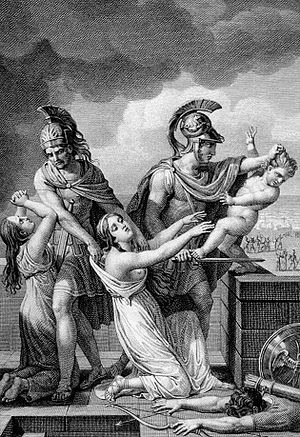
In one version, Astyanax
is thrown from Troy's walls.
In my version, of course, Terry never goes that far. His exile is planned with Alim's help. 

But the leaders' reaction to Terry in Gilman's book--and Gilman's praise of eugenics (and Gilman's later sanguine acceptance--alongside other intellectuals of the time--regarding WWI's "purging") shadow the dangers to Alim. Alim is a literal representative of the unprogressive mindset. He is Astyanax, Hector's son, a lingering remnant of the so-called evil past. 

For a culture that believes in "breeding," Alim would be a throwback. After all, at the end of the book, only supposedly completely progressive Jeff actually breeds in Herland. (Van and Ellador leave, then return.)

As my Moadine points out to my Terry (she is as ruthless as Gilman's Moadine):

“You three men are acknowledged intruders. And, too, your presence has temporarily quelled questions about the ‘other sex.’ But Alima, Alim, is a citizen. Any restrictions on him would be resented—by Alima and by his friends. He would be defended. But yes, some citizens would wish to send him away—because of his past, because he represents going back rather than forward.”

Astyanax, Andromache & Hector

“He is a boy, not a symbol. What kind of society is this that you can’t incorporate him?”

“The truth of him would cause conflict.”

“You think conflict won’t arise anyway? You think male distinctiveness is the only distinctiveness? Suppose Celis was more of a go-getter? You really think Tyra and others could keep her in place?”

The smallest smile touched Moadine's lips. “No. But destruction is always to be deplored. Should we start that battle now?”

Over one boy, a boy who could be persuaded to leave.

The argument here is between the reality and the label, or, rather, self-fulfilling label. As with all utopias, the problem is created by the utopia itself

If a society determines that certain people are "good mothers" and certain people are "bad mothers"--if it focuses on breeding as a way to remove the criminal element from human nature--if it insists that human nature must "progress," not in terms of functional governments and intelligent policies but in terms of inherent human nature--the enforcement of that mindset will follow. Tolerance ends at the point where "primitive," non-progressive, very human nature rears its head. It isn't supposed to return! Therefore, it must be eradicated! 

Rather than a frank and honest appraisal of human nature, labels become judgment--and self-deception. Terry's crime in the book is unacceptable (as my Terry acknowledges). The utopia's downfall arises not from Alima's reaction--and Terry's exile--but from the surprise of the entire society that the label (we are a self-congratulatory pristine society who exercise the following advanced philosophies) didn't carry more weight than the circumstances. No infrastructure or law exists to handle the circumstances because, well, really, those circumstances shouldn't have arisen at all, now should they have?

Human nature is the battleground that utopias can never overwhelm and scorch from existence. The attempt to do so anyway--rather than accepting human nature as part of the equation--creates outcomes that far outstrip human nature in viciousness. Utopias are, in sum, dystopias in waiting.    

Chapter 14

His in Herland or Astyanax in Hiding

The Problem of Chronocentrism: Part III, Labels versus Thought

"[T]he public, the populace, the citizenry,
must be provided with the correct
feelings! Sentiments...are insisted upon
in all public utterances."

In Chapter 15, Terry convinces Alim to leave Herland or Troas. He also determines to get himself chucked out by breaking taboos.

As Alim states, 

Terry was convinced that he needed to...force the leaders to deal with him as a malefactor or transgressor.

In retrospect, the plan was unbelievably risky. Any culture—no matter how polite and so-called civilized on the surface—can descend into anarchy and witch trials.

Not that I knew that then. To a coddled teen, Troas appeared entirely predictable. Boring. To Terry, it appeared merely restrictive. Both of us were tempting fate, Terry especially. He was hoping for exile. He could have gotten worse.

And as Terry states,

Bureaucracies are the same the world over. The leaders were discussing us—or, maybe, just me. Jeff wanted to stay in Troas. Van would stay or go to be near Ellador. In the meantime, there was no indication the leaders would encourage or allow or permit (whatever terms dictators use to convince themselves of their compassion) such a dangerous, unworthy, harmful course of action as Ellador or Alim leaving Troas.

The tension here is between the reality of the utopia and what it pretends about itself.

Chronocentrism, Part III

 The ego-centered belief that we suffer more than our ancestors is irritating.

The ego-centered belief that we have progressed far beyond our ancestors is more understandable. It is still incredibly self-centered

Progress does exist. Medicine. Education. "Givens" regarding rights. The early years of the Common Era produced fresh ideas about the individual and God, ideas which filtered across many cultures and greatly improved conditions for individuals everywhere. As Rodney Stark points out, the Dark Ages are only dark because of how little we know. In general, life got better when the Common Era hit.

The arrogance comes into play not so much with the material goods and opportunities that we've gained. Those should entail a humble response: I'm so glad to be alive now! The arrogance comes into play when people in the past are treated with smug contempt. 


The smug contempt sounds something like this: 

"Those primitive ancestors of ours didn't know any better when it comes to science and religion and the social order. We do. We are moving forward, beyond their silly thoughts and clearly shallow thinking based on our advanced theories and our talent for maintaining those advanced theories! We don't even have to refute those idiots of the past. We just have to roll our eyes over them like high schoolers at the prom. Har har har. Let us contemplate our magnificence!" 

Herland rests on the above thinking--to an extent. Gilman's perspective is rooted in nineteenth-century Progressivism; the mindset--we have progressed beyond our backwards ancestors--shows up in Victorianism even before Darwin. (Evolution as progression wasn't his precise argument, but what people thought he was saying fit well with the ethos of the time.) It continued until two World Wars turned it into a nonsense. It is now back in a slightly different guise. 

The problem is not that the world isn't materially better (despite all the bad stuff) than it was thirty to fifty to a hundred years ago. The problem is the adoption of a label or attitude: "Because I'm not as backwards as they, I'm automatically better and don't have to consider anything other than congratulating my bubble existence and echoing what my group/clique/mob says." 

This we're-so-much-more-thoughtful-and-cultured-and-insightful insistence shows up in every area of life (not just politically-focused social media, though it flourishes there). A few years ago, I encountered an article by a woman proclaiming how far she has risen above the backwards theological assumptions of her church: In this day and age, sin and guilt are such déclassé concepts! So tacky! I'm beyond all that!

Okay, was my thought. What do you have to offer?
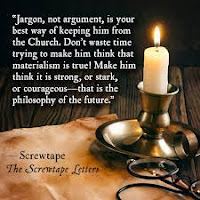
What she had to offer were ponderings from her naval; big thoughts about the nature of the universe based on..."MYSELF" (I'm not kidding).

Not exactly Thomas Aquinas.

Gilman goes down the road of the aforementioned me-myself-and-I writer. In fairness, Gilman argues that just as the current generation of Herland's citizens is building on the ancestresses' achievements, so shall the next generation build on the current leaders' achievements. She acknowledges that their ideas (Gilman's ideas) might prove to be lacking--which is good, cause they were.

And she argues against infant damnation, which is a positive.

The problem, as my Celis character points out, is that Gilman doesn't argue against infant damnation using logic, faith, or, simply, a better idea--as plenty of people did, including Joseph Smith. She argues against it by having Ellador break down in tears (again, I'm not kidding). In His in Herland, Alim and Celis have this exchange: 

I [Alim] never paid much attention to Ellador and Van’s philosophical discussions. I shrugged. 

Celis said, “Van, bless him, tried to explain to Ellador about infant damnation. It’s a belief from the other world’s history. A belief that unbaptized children—children who are not inoculated against the sins of their ancestors—are doomed to hell.” 

“That’s unpleasant,” I said. 

“Of course it is. But it’s part of a bigger theology. Religions are complex. People are complex. Understand the idea, understand how people think. Then, you can challenge the religion or the philosophy directly. Yet Ellador ran off in hysterics to a Temple Mother.” 

Celis’s tone was fondly exasperated. 

“And of course, the Temple Mother told her, No, no, that sort of thing can’t be true. Only ignorant people ever believed it. Ellador’s no fool. She realized immediately that dismissing the idea wasn’t going to make it easier to grasp that big picture she’s always pursuing. She should have known better than to run to someone who wouldn’t talk to her as honestly as Van. But she did. That’s why mentors like Tyra put up with her. Because Ellador is appalled by the right—or, rather, wrong—things. She’s offended when appropriate. Appreciative when appropriate. She’s a ‘good’ girl.”

In other words, Herland's religion has nothing to offer in the place of Presbyterianism, not even anything as witty as Twain's quote. It offers a kind of generalized "we're better" self-label, a kind of "in" group culture filled with rules, cultural appropriateness, and "good thoughts." It's entirely substanceless, in part because it rests on the premise that it doesn't have to justify itself. The quality of being advanced is supposedly enough.

The end result of such smug self-satisfaction (I'm upset about the right things! I curse the right things! I hate the right people! I cry at the right times! I embrace appropriately worthy people and ideas!) is a remarkable lack of critical thought. That is, the pretense or performance or presentation--Look at our wonderfulness!--is more important than thinking about...anything, really. 

My personal theory is that Utopians are actually hunting for safety.  In truth, I'm not sure they are even aware that under all of the boasts of advanced thinking and edgy ideas, they are in fact...

Intensely reactionary, the kind of reactionary that belongs in countries run by dictators and religious oligarchs. It is less about holding the course (conservatism) or respecting the individual (classical liberalism) and more about retreating to something almost entirely imaginary based on an almost entirely constructed imaginary past.

Take the current so-called "revolution" on gender. The end result is not a broadening of gender or understanding of human self-perception and sexuality but, rather, "girls must like pink stuff and dolls" while "boys must like trucks and sports." In the meantime, schools that push pronouns on little kids create psychological havoc. Kids are fully capable of liking multiple things at once. Being forced to parse dinosaurs, sports, and unicorns is, to them, weird. 

They are right. It is weird.

My generation asked questions like, "Is it okay for men to cry?" and "Hey, what about women astronauts?!" Simplistic maybe, but we were headed in the right direction. Expand, not retract.

The categories being fed these kids are more reminiscent of Victorianism than anything in the last fifty years. 

Gilman does the same. To be honest, I've never fully understood her take here, since she suffered post-partum depression after the birth of her daughter and wasn't really an Earth Mother type. Yet Herland is entirely devoted to a gender imperative. The purpose of women is Motherhood, and yes, the "m" is capitalized in the book. 

Perhaps Gilman felt guilty about her own lack of motherliness. She may have embraced the idea of Utah polygamy whereby a woman could go to college while other women watched her kids. Or perhaps Gilman wanted to make her utopia palatable to her audience. Or perhaps she truly embraced the idea of improving future generations: bringing up children should be done right. (Her daughter and she had a strained relationship, which isn't made more understandable by recent scholars wanting the daughter to have had a different attitude towards her "great" parent than she actually did or cared to have or thought about.)

To Gilman's credit, she pairs Motherhood with Fatherhood. 

And Terry objects. 

Interestingly enough, although his objections in the book are portrayed as somewhat sexist, they resonate with a modern audience. When he proclaims, "What a man wants from women is more than all this Motherhood," he sounds like a feminist!

His objections to Fatherhood are equally strident. 

Terry is arguing for the individual. 

So many utopias falter on the need to tell citizens what roles they must adopt. Like dictatorships and American Ivory Towers, utopias really like the idea that people have been properly pigeonholed.  

In reality, revolutions are often far less "new" than they like to pretend. 

Chapter 15

His in Herland or Astyanax in Hiding

The Problem of the Closed Narrative or The Problem of Theory

On the surface, identity politics shouldn't be evil. Although I'm not a fan of labels, hey, language is language. It has to exist for people to communicate. Identifying a group is part of that process. (Historically speaking, "stranger" shows up in nearly every language early on in that language's development.)

Unfortunately, inevitably, identity labels get linked to a "closed" narrative, a story that is self-explanatory and set in stone.

An "open" narrative in which people may change based on new information, new goals--where to live, whom to marry, what to work at, what to eat, how to behave--entails two things: (1) risk; (2) responsibility.

That is, a person in an open story will say, Maybe I made the wrong choices. But I made them, and I can't go back, so I'll live with them. But what does that mean for the next choice? After all, I'll have to answer for it.

The popular version of CRT--the secular version of "the Spirit made me do it" (John McWhorter is right about the religious conflation)--is the exact opposite. The underlying ideology propounds that a theory or label supplies all the explanation a person should need or want; recognizing the validity of that explanation will, like recognizing the Spirit, supply all the required (entirely abstracted) sense of self and responsibility. 

Unfortunately, as Jonathan Edwards and other New Calvinists discovered, all the revivals in the world don't necessary lead to anything but...another bunch of revivals. The experience or "performance" becomes its own pursuit.

That is, adopting the group's identity or explanation doesn't automatically entail self-understanding or critical thinking or personal change or long-term change. 

In Chapter 17, Terry is on trial for his attempted assault on Alima. In my version, of course, the assault is a contrived event between Terry and Alima. However, Terry objectively accepts that by all appearances, he did break the law, violate a social standard. 

During the trial or hearing, Terry suggests a reason why people so readily adopt theory--ready-made identities--when life--relationships, communication--gets messy. 

I [Terry] said [to the Councillors], “I assumed agreement existed.”

Rather to my surprise, many of the Councillors nodded. Apparently the “you should ask at every stage of the seduction” approach hadn’t arrived in Troas.

Of course, the women of Troas are realists. People make assumptions about others’ needs. That’s life. Since we are not (yet) tools of A.I., we don't spend every minute of every day filling out questionnaires: check Box A or Box B.

No one wants that form of communication anyway. We want to be instantly understood—the centers of others’ universes—which wish inspires its own problems. Because--also reality--since we don’t adopt others' versions of our best selves, why would they agree to ours?

I waited resignedly for the Councillors to suggest the contemporary alternative. Since most people don’t halt their behavior to ask permission—and only compulsives and high school bullies justify continual “I saw you do that!” policing—the compromise is usually, “But the proper path should have been obvious."

Not obvious due to honor or training. Obvious because of identity. Join the group, adopt the designated label. Proper attitudes will be downloaded into your brain. All answers delivered. All stories decided upon. A closed book.

Don’t tell me modern Westerners don’t believe in fate.

Terry goes on to consider that being excused because of membership in a group sounds good but lacks the moral punch of "you messed up; you should pay." 

And Terry gets thrown out. Luckily, he wants to go. 

Chapter 17

His in Herland or Astyanax in Hiding

The Problem of Disillusionment

At the end of His in Herland, I had to determine Alim's reaction to leaving his hometown and his country. It would have been easy--too easy--to give him a spat of disillusionment: Stupid utopia! Stupid adult authority figures! Stupid everyone! I'm a rebel, yo! 

I didn't. As mentioned elsewhere, utopias are dystopias in waiting. Utopians are almost always disillusioned souls waiting to be disillusioned all over again. 

And disillusionment would miss the point. 

Reason 1: Despite my criticisms of utopias, my ultimate point is that Herland or Troas isn't one, no matter how much it wants to be. Like Miss Marple always finding the village corollary to the big bad city murderer, I argue, You thought you were so edgy and avant-garde. You're not. You're just like every other social order. Get over yourself. 

Which means Herland/Troas offers good and bad stuff. In fairness to Gilman, she crafts a world that is gorgeously pro-child. Alim would carry that away with him. 

Reason 2: Blaming parents, God, social orders, the past is easy. Scapegoating is easy. Developing narratives and abstracted theories that shovel the blame onto history,  a being, a specific group is easy

Personal responsibility is hard and therefore, more interesting

I like Alim. As his creator, I want him to grow up, not trade on a self-involved, self-pitying narrative and/or call on a "higher order" that allows him to hide behind rules/someone else's demands. I don't want him to wallow in how unfair his life has been. 

His father died in ancient Troy. His mother was killed by monsters soon after. He wandered for generations underground. He had to hide his sex when he went to the center of his own country. 

Yet as Terry would say, "So what?" 

As Eugene, The Translator, states:

[W]e are all products of our culture and rarely think to question it. Fish discover water last. It's always easier to point at those other people in that other culture. I think there are a whole lot of unhappy people in the Occident [like everywhere else] who can't divorce themselves from the culture that defines the boundaries of their lives and end up trapped by those expectations.

Like the nature versus nurture debate, splitting the difference is a good place to start. But that means half is on you.

Alim is more reflective than Terry. However, Terry is his mentor. Terry's is the perspective he adopts. 

And it lends him grace. He makes choices, then accepts the outcomes, good and bad. That's life. In the meantime, he can appreciate what he has gained, what he hopes to gain, what life offers. 

In sum, hope is more creative and satisfying than disillusionment. 

Chapter 20 & Chapter 21

His in Herland or Astyanax in Hiding


The Problem of the So-Called Right Side of History

A great many problems with the utopia come down to the idea that there IS a right side of history. 

It's an idiotic concept.

I am not suggesting that right and wrong don't exist. I am suggesting that the phrase is loathsome and mindless (no matter how the phrase is interpreted: the "right" side of history is the side that will win, become popular, be obviously correct to future generation or the side that should win).

The phrase is loathsome and mindless for the following reasons:

1. Babies and bathwater 

Good events and values and outcomes rarely come un-entwined with other stuff. 

There's a great Black Adder episode in which an election takes place. It is the Regency Era and one of the candidates wants "the ending of slavery and the compulsory eating of asparagus."

The reporter says, "I understand your point about asparagus but what's up with your stance on slavery?"

The (entirely historically accurate) point being made is that many people (Abolitionists, Millennialists, and Reformers) in the same era had what we moderns would deem rational and valid ethical points about the treatment of others. Unfortunately, they tended to combine those rational and ethical points with ideas that strike many modern folks as...nuts--such as the compulsory eating of asparagus.  

Likewise, advancements that strike people as utterly rational will get paired with ideas that MIGHT seem valid at the time but in the end turn out very much not to be--such as the pairing of birth control with eugenics in the early twentieth century.

2. Chronocentrism

How much is the "right side" based on perception?

I mention elsewhere that Ancient Athenians in 590 B.C.E. could be excused for believing that democracy as an experiment had entirely failed; Jews and Christians in 70 C.E. could be excused for believing that their belief systems would remain small and constantly under literal fire. And for those people in that time, that was the reality. 

But democracy is now with us as is Judaism and Christianity. 

Wouldn't Ramsesses II from 1200 BCE be surprised?!

As for Henry VIII...actually, I don't think Henry VIII would be surprised to see his line replaced: he was that paranoid. 

But Shelley's poem (above) is entirely appropriate. What people thought would die didn't. What people thought would persist didn't. There can be no "right" side if the sides completely change personality or no longer exist.

3. More chronocentrism

Likewise, saying, "The winners write history" depends ENTIRELY on when one stops and looks back. 

In my posts on the Protestant Reformation, I point out that at different points along the line from Henry VIII to William of Orange (who was more interesting than I realized), any particular group could be excused for thinking, "That's it! My side is over and done with!" or "That's it! My side won! Ha ha ha!"

For that matter, the Calvinists or Congregationalist in late eighteenth-century America could be excused for blithely assuming (as they did) that Congregationalism would always be the most influential Christian sect coming out of New England. 

Yet between 1750 to 1850, they were almost entirely replaced by Baptists and Methodists with the Catholics remaining steady. 

As the late great PJ O'Rourke points out, attitude also contributes to that "when"--see quote above and #4.

4. Arrogance

Are you in the right? Really? 

Really?

The supporters of eugenics believed that they were absolutely on the advanced "here is what the future will look like" side of history. And the philosophy/cause spread across political parties. Political libertarians and Catholics were treated like America's nutty, delusional, cat-mad aunts for standing out against what appeared so good and righteous and inevitable.

Going back further, the Salem Witch Trials were criticized by one Mather and supported--at least the legal aspect--by another.

My posts about the Protestant Reformation involve a queen who was threatened for not going far enough, another queen who thought she was restoring the true religion to the country, a bunch of fanatics who felt entirely justified in killing a king, and so on and so forth. 

I am not arguing against taking a position on a topic. Waffling also has its problems. As Mike Baxter points out, "naming public institutions after the most boring people we know" may have its advantages but can backfire. The "safe" name or position now may not be "safe" tomorrow. 

A position that can't see the flaws, the problems, the possible arguments against itself...

...is not the "right side of history." 

It's just a side with blinders on. 

5. Imperfection makes an event memorable--not someone being lucky.

Like many causes/events that have run out of control, the Salem Witch Trials at their height were almost impossible to criticize. People who dared could end up in jail and then hung. 

And yet people did criticize it. And many of those critics--Puritan ministers from all over New England--believed in things we moderns would deem wrong and bizarre. But they also raised points about what constitutes evidence that we would comprehend and even support. The second trial never went forward due to a combination of political events, scandal (the young women were accusing more and more people unknown to themselves), and growing criticism. 

Within a decade of the trials, some people who had taken part made public formal apologies. 

Is the event memorable because it was so awful? Or memorable because people at the time actually regretted it? The event stands out in colonial memory as being an aberration rather than what it likely would have been a few decades earlier, just another day in court. 

When we are in the moment, the time, the years, we behave like the satire (I believe) by Dickens in the opening to A Tale of Two Cities: "It was the best of times; it was the worst of times..." We think the entire universe circles around us and our emotions and our experiences.

Professor Aldrete

In truth, whatever we may imagine or wish or dread, life doesn't stop to dole out chastisements or congratulations; it keeps moving forward. In a few years, what seems of great importance fades or, possibly, becomes terribly important and...people still move on to something else. The biggest fault with social media is the fundamental lie that we are the center of other people's worlds. (I suggest that most mental issues surrounding social media come down to our animal natures being forced into a contrived spotlight, a condition that simply doesn't match reality.) 

Truth: most people--most ordinary people within history--have done the best they could at the time the best way they could based on what they could best discern. They weren't the center of anything. Their deeds, in the long run, meant a great deal to the people around them but little to history books. 

In other words, non-wealthy, non-writing, non-powerful, non-remembered people, which is nearly everybody, those people who had families and farms and jobs, who went to festivals and underwent ceremonial rites, who taught things to others and discussed stuff and told stories...those people were muddling along, just like the people before them. Just like us. They deserve respect rather than theoretical labels, name-calling, and "wrong side" disdain.

"The right side of history" isn't just stupid. 

It lacks compassion.