Showing posts with label Eugenics. Show all posts

The Problem of Obsolescence

Anne Morrow Lindbergh was also a decent woman
who said really dumb things.
Gilman tackles her utopia from the viewpoint of nineteenth-century Progressivism. Some of her ideas have substance. Some are shallow beyond belief. And some...

Are deeply troubling.

Occasional Gilman defenders try to argue that Gilman's more distasteful attitudes arose later in life, after she said all the stuff the defenders approve of. In truth, a great many of the not-so-palatable ideas show up in Herland's sequel, which was begun in 1916. And they creep through Herland.

However, I believe in being fair to historical figures, just as I would want future people to be fair to me. 

Gilman is writing pre-World War I and World War II. Elements of nineteenth-century Progressivism that strike one, now, as tainted by mid-twentieth century events, were not (necessarily) then. 

Such as, just for example, eugenics. 

Gilman is completely on-board with genetic modification. Everything from grain to cats to humans is "bred" to help produce an advanced society. "Bad" citizens--a concept Terry lambasts several times in both Gilman's version and in mine--are encouraged to not produce offspring (a kind of "hold it in" form of birth control), all for the sake of the race. There are no criminals--though there are guards and a fortress--since that tendency was bred out, just as the poor cats were bred not to kill song birds.

The skin does indeed crawl--and Gilman's sequel is worse. She practically argues that war (World War I) is okay because it will wipe out the degenerates--and put those uncomfortably clannish Jews in their place (yup! the left has always been far more antisemitic than it pretends)--so the world can do better the next time. 

Gilman was truly not this awful, any more than Anne Morrow Lindbergh (see above) was (Charles Lindbergh kind of was, but that was his personality, which rested on the premise "I am the cleverest man in the universe"). 

Like Anne Morrow Lindbergh, Gilman had not yet seen where such theories lead. The Holocaust was not yet part of history. 

Now that I've let Gilman off the hook, I'm going to put her back on it. Although eugenics was considered acceptable in the early 20th century and plenty of people on both the left and the right promoted ideas connected to eugenics, there were people and groups who did not, including civil libertarians and Roman Catholics. 

And guess what? They were mocked as backwards and reactionary and not on the "right" side of history!

But again, Gilman had plenty of company--and, again (to be fair), she propounded a non-violent, non-aggressive approach that would take multiple generations to accomplish.

Still, the argument is distasteful. As Terry points out, Van and Jeff go along with the mentors because although genetic determinism is tainted, both men adhere to populist ideas about environmental determinism, i.e. social structuring through language and name-calling. 

Same argument. Different skins. 

"If sports is a childish substitute, I can live with that."

Another of Gilman's arguments, though less distasteful, runs down the same rabbit-hole. Like many nineteenth-century socialists who yet despised the communal aspects of communism, she wanted the competition of capitalism to produce big brother firms that would care for individuals. She was pro-competition as far as it sustained an economy but not so far as it was generated by the individual. 

In Chapter 9, Alim attempts to defend team sports. Gilman wasn't necessarily opposed to athletics. The women in Herland freely climb trees and exercise. However, she fails to appreciate that the "non-nice" aspects of competition are not something that can be excised, the "nice" parts left standing. 

Get the trains to run on time by all means--but those who defend utopias want to do it without the more unpleasant aspects of competition (firings and bankruptcy). Of course, eliminating the unpleasant competitive side often means forcing people to work for free or under threat. 

Lots of utopians fail to grasp this babies and bathwater point. As my Terry states in frustration:

Van argues that Troas sustains the individual--while eliminating the "unhealthy" aspects of individualism: excessive competition, excessive consumption. But the argument rests on the presumption that one can carefully select on the one hand without damaging on the other. Breed citizens for greatness--surgically remove their unlikable parts--without violating their individuality and denying their biology. 

When a country rests on such circular logic, can anyone get out?

In any case, Herland is a cautionary tale to utopian builders. Every utopia risks looking reactionary within a few decades since any social order that claims to "fix" human nature (piecemeal or otherwise) will be disproved in time--sometimes very, very violently. 

Chapter 9

His in Herland or Astyanax in Hiding

The Problem of Self-Fulfilling Labels

One issue that I faced with my male Alim in His in Herland was,  

Why should he have to hide? 

The male intruders--Terry, Van, and Jeff--don't. So why Alim?

Interestingly enough, the answer lies in the underlying "forward-thinking" ideology of most utopias. 

In Gilman's Herland, Terry, Van, and Jeff are treated as representing a current, contemporary, forward-moving culture. Van is embarrassed to admit how much society has not advanced (considering that the world was on the brink of World War I, "not advanced" is something of an understatement). Jeff is gleeful at the comparisons that put American/European society in the wrong. Terry doesn't care, except he wants to leave. 

The leaders of Gilman's Herland monitor and supervise the men throughout their stay, though Gilman pretends they don't. They are never given any "legal" rights, such as voting or governance--not even the equivalent of driver's licenses!

The implication is that Van and Jeff, at least, have progressed far enough, they can be "educated" to the new way of living. Terry is a throw-back and therefore ungovernable and unmanageable. In the book, when Terry attempts to rape his wife, Alima, the answer is either to eject him or kill him. Moadine pronounces that death would be "kinder" than locking him up. 

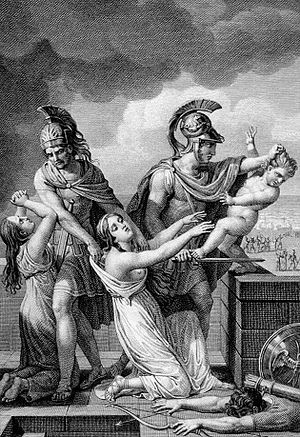
In one version, Astyanax
is thrown from Troy's walls.
In my version, of course, Terry never goes that far. His exile is planned with Alim's help. 

But the leaders' reaction to Terry in Gilman's book--and Gilman's praise of eugenics (and Gilman's later sanguine acceptance--alongside other intellectuals of the time--regarding WWI's "purging") shadow the dangers to Alim. Alim is a literal representative of the unprogressive mindset. He is Astyanax, Hector's son, a lingering remnant of the so-called evil past. 

For a culture that believes in "breeding," Alim would be a throwback. After all, at the end of the book, only supposedly completely progressive Jeff actually breeds in Herland. (Van and Ellador leave, then return.)

As my Moadine points out to my Terry (she is as ruthless as Gilman's Moadine):

“You three men are acknowledged intruders. And, too, your presence has temporarily quelled questions about the ‘other sex.’ But Alima, Alim, is a citizen. Any restrictions on him would be resented—by Alima and by his friends. He would be defended. But yes, some citizens would wish to send him away—because of his past, because he represents going back rather than forward.”

Astyanax, Andromache & Hector

“He is a boy, not a symbol. What kind of society is this that you can’t incorporate him?”

“The truth of him would cause conflict.”

“You think conflict won’t arise anyway? You think male distinctiveness is the only distinctiveness? Suppose Celis was more of a go-getter? You really think Tyra and others could keep her in place?”

The smallest smile touched Moadine's lips. “No. But destruction is always to be deplored. Should we start that battle now?”

Over one boy, a boy who could be persuaded to leave.

The argument here is between the reality and the label, or, rather, self-fulfilling label. As with all utopias, the problem is created by the utopia itself. 

If a society determines that certain people are "good mothers" and certain people are "bad mothers"--if it focuses on breeding as a way to remove the criminal element from human nature--if it insists that human nature must "progress," not in terms of functional governments and intelligent policies but in terms of inherent human nature--the enforcement of that mindset will follow. Tolerance ends at the point where "primitive," non-progressive, very human nature rears its head. It isn't supposed to return! Therefore, it must be eradicated! 

Rather than a frank and honest appraisal of human nature, labels become judgment--and self-deception. Terry's crime in the book is unacceptable (as my Terry acknowledges). The utopia's downfall arises not from Alima's reaction--and Terry's exile--but from the surprise of the entire society that the label (we are a self-congratulatory pristine society who exercise the following advanced philosophies) didn't carry more weight than the circumstances. No infrastructure or law exists to handle the circumstances because, well, really, those circumstances shouldn't have arisen at all, now should they have?

Human nature is the battleground that utopias can never overwhelm and scorch from existence. The attempt to do so anyway--rather than accepting human nature as part of the equation--creates outcomes that far outstrip human nature in viciousness. Utopias are, in sum, dystopias in waiting.    

Chapter 14

His in Herland or Astyanax in Hiding